
Alya Bath · Planning and advice
Bathroom Vanity Storage: Plan Around the Drain and Daily Use
Assigned editorial date:
Actual published: · Updated:
This is a newly written post. Its assigned editorial date is not evidence of past publication.
A vanity can look generous from the outside and still leave you searching for toothpaste behind a drainpipe. Plan bathroom vanity storage around the items you actually use, the space left by the basin and plumbing, and the way each door or drawer opens. Exterior width alone won’t tell you what fits.
Alya Bath is a bathroom vanity manufacturer and distributor serving resellers and trade professionals. Its vanity catalogue offers useful examples of different storage layouts: a wider double-sink model can have fewer drawers than a narrower single-sink model. We can use those documented differences to ask better questions before choosing a cabinet, without guessing its interior capacity.
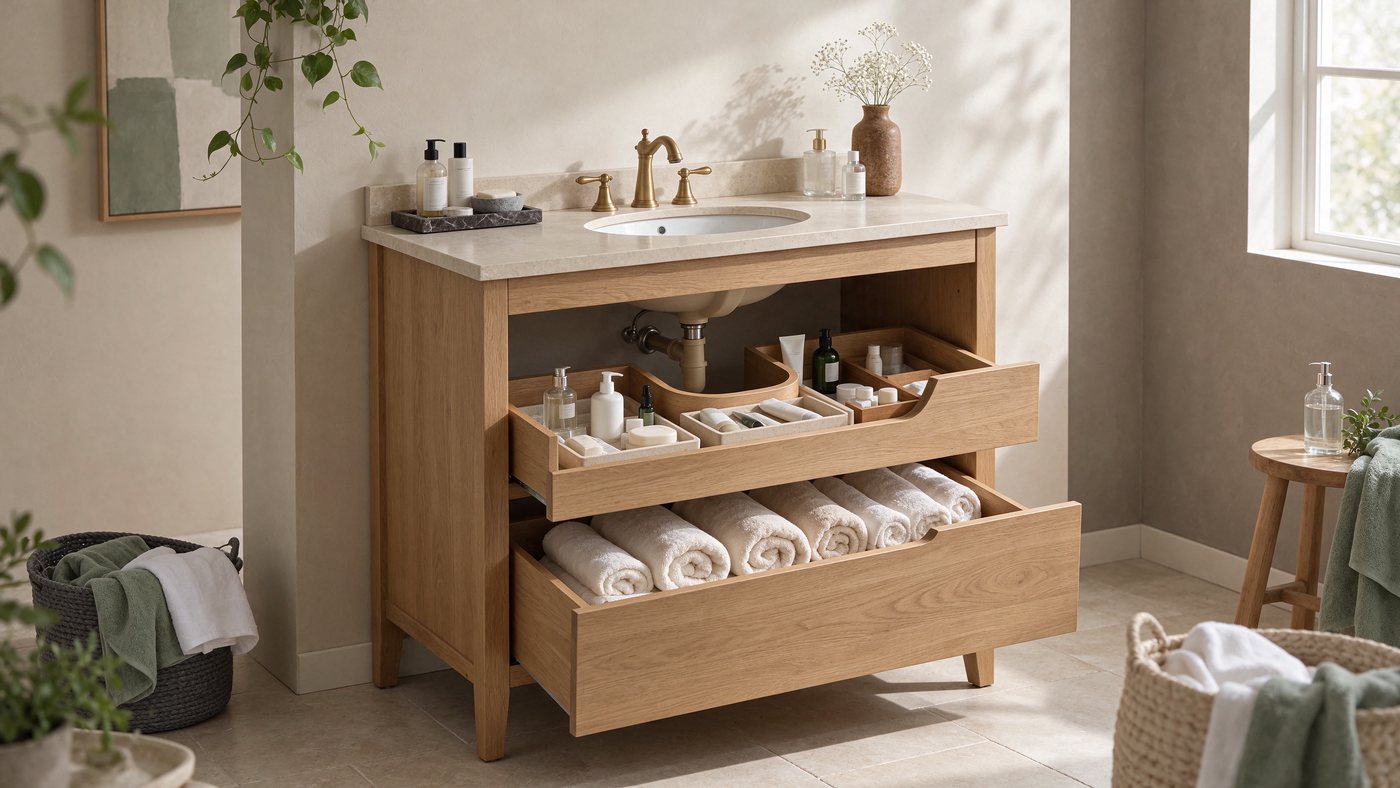
AI-generated new concept illustration; not a recovered original, actual Alya Bath product photograph, measurement, or verified depiction of any specific SKU or facility.
Start with the items, before buying organizers
A drawer full of half-used tubes can make a cabinet seem too small. For example, a daily face cleanser may sit behind several unopened replacements. Empty your existing vanity and separate the products you use from spare stock and items that belong elsewhere. This tells you what storage problem you’re solving before you buy another bin.
Record each item’s owner, frequency of use and storage instructions. Measure tall bottles upright, including their pumps. Measure a hair dryer with its handle and loosely gathered cord, rather than measuring the barrel alone. For folded cloths, use the stack you actually intend to keep.
A hypothetical household item audit
Imagine two adults planning storage for the following inventory. This is an example, not a claim that these items fit a particular Alya Bath model:
- Eight daily grooming items: small tubes, containers and brushes. Try separate shallow trays for each person so one routine doesn’t require moving the other person’s supplies.
- Three tall bottles: measure their upright height and footprint. Consider a door-access area only if the bottles clear the basin, pipes and hinges.
- Four washcloths: test the folded stack in a dry drawer, separate from containers that might spill.
- Two spare toiletry packages: reserve a less convenient position for these rather than displacing daily items.
- One hair dryer: allow space for its full shape and cord in a dry location, following the appliance’s storage instructions.
That inventory is 8 + 3 + 4 + 2 + 1 = 18 objects. It isn’t a capacity calculation: eighteen small tubes and eighteen bulky bottles need different amounts of space. Medicine bottles and cleaning products aren’t included; assess their safe storage separately.
If everything won’t fit, reduce the amount of spare stock assigned to the vanity before sacrificing access to everyday items or plumbing. A cabinet packed to its edges leaves little room to remove a bottle cleanly or spot a leak.
Reserve the plumbing and service-access zone first
A storage basket may fit on the cabinet floor yet hit the trap when you pull it forward. The trap is the curved drain section beneath the basin; the basin itself, supply valves and connected hoses also reduce the available space. Treat this occupied area, plus the access needed to inspect and service it, as a plumbing exclusion zone in your storage sketch. This is planning language, not a fixed code clearance.
For an installed vanity, inspect the actual layout without disconnecting anything. For a proposed model, request an interior drawing and compare it with your measured drain and supply locations. Use the vanity measuring workflow to record the site, then check the plumbing layout guide for cabinet compatibility.
Mark where you need to reach the shutoff valves and see the drain connections. Keep organizers removable so routine inspection doesn’t require dismantling a storage system. Don’t hang items from pipes, force a bin against a hose, or fill the space around a valve with loose supplies.
A cutout drawer may pass around the drain, but its remaining storage area can be an irregular shape. Ask for the clear dimensions of that shape. Don’t solve interference by cutting a drawer box or cabinet structure yourself; have the installer review the exact model instructions and plumbing arrangement.
Match drawers and doors to the way you retrieve things
A tall lotion bottle can stand behind a door but prevent a shallow drawer from closing. Conversely, a small tube can disappear at the back of a deep cabinet. Choose the access pattern that suits the item, then verify the physical fit.
Drawers are useful for separating small daily supplies because they bring the contents forward. However, a drawer front doesn’t reveal the clear width, usable depth or height below the basin. Check how far the drawer opens and whether you can see and reach its rear contents. Self-closing hardware doesn’t establish full-extension travel or a load rating.
Door-access storage may suit upright bottles or removable bins. Measure the opening through which the bin must pass, including any hinge intrusion. A container that fits inside can still be awkward to remove through a narrower doorway.
Door-mounted racks need their own clearance check. With the rack loaded, confirm that the door closes without contacting the drawer boxes, basin or plumbing. Ask whether the door and hinges permit the accessory and its weight before attaching it. Leaving the door bare is a better choice than adding storage that prevents proper closure.
What AT-8041 and historical AT-8043 records actually show
Two cabinets can offer very different storage access even when the wider one appears more spacious. Alya Bath’s recovered Ripley records illustrate why you should compare drawer and door layouts before treating width as a storage benefit.
AT-8041: four drawers and one door
The Ripley AT-8041 39-inch vanity records list four drawers, one door and one sink. Its documented overall dimensions are 39.25 inches wide × 18.75 inches deep × 33.13 inches high. The Black, Gray and White records describe a freestanding MDF/wood-veneer cabinet, white acrylic top/sink, self-closing door and drawers, and an opening for plumbing. 1
For our hypothetical household, four drawers could offer separate places for personal supplies and cloths—but only after their clear dimensions are confirmed. The record doesn’t tell us that every drawer holds a tall bottle, or that the door conceals an unobstructed compartment. An optional side cabinet was described as not included; don’t count it as part of the vanity.
Historical AT-8043: three drawers and four doors
The historical Ripley AT-8043 56-inch vanity Gray, Light Oak and White records list three drawers, four doors and two sinks. Their overall dimensions are 56.50 inches wide × 19.88 inches deep × 33.13 inches high. They also describe freestanding MDF/wood-veneer construction, a white acrylic top/sink, self-closing doors and drawers, and a plumbing opening. 2
This wider model has fewer documented drawers than AT-8041. Four doors don’t prove there are four separate compartments, and two basins require checking both plumbing areas. Request the interior layout before assigning each user a storage zone.
These counts belong to the historical 56.50-inch records. Separate newer 60-inch double-sink records also use AT-8043 codes; don’t transfer dimensions or the four-door count between them. Neither historical example provides verified drawer-interior dimensions or usable storage volume.
Put daily supplies where the user can reach them
A well-sorted drawer still fails if its user has to crouch awkwardly or step aside to open it. For example, one person may be able to reach the rear of a lower drawer comfortably while another cannot. Test the actual motion from the position where you stand at the basin.
Assign the easiest reachable space to daily supplies. Keep occasional items farther back only if you can retrieve them without lifting several containers. Labeling a tray by person or routine can make shared storage easier to maintain, but the tray still needs to come out and go back without snagging.
For children, accessible storage should contain only items adults have judged appropriate for independent use. Hazardous products need a separate safety decision. For room-wide storage, niches or shelves, use the family bathroom article and small bathroom remodel tips rather than expecting the vanity to hold every household supply.
Keep hazards out of convenient daily-use storage
A lower cabinet is convenient for a cleaner, which also makes it accessible to a young child. Ordinary self-closing doors aren’t child locks. The U.S. Consumer Product Safety Commission recommends keeping chemicals and cleaning supplies in a locked cabinet or box, out of children’s reach, and in their original child-resistant containers. Don’t decant them into decorative jars or place them in a child’s grooming tray. 3
Medicines need more than a tidy drawer. MedlinePlus warns that bathroom heat and moisture can damage them. Follow the medicine’s label and ask a pharmacist about storage requirements; choose an appropriate cool, dry, secure location rather than assuming the vanity is suitable. Keep medicines in their original containers. 4
A hair dryer needs safe storage too. Unplug it after use and keep it where it cannot fall or be pulled into a sink or tub, as CPSC advises. Follow the appliance instructions and allow heated tools to cool before putting them away. A storage plan is not permission to operate or charge appliances inside a cabinet or to add an outlet yourself. 5
Test the loaded layout before committing to accessories
An empty drawer can close smoothly while a loaded tray catches on the basin above it. Before buying organizers, use their proposed dimensions to make a paper footprint or cardboard mock-up in the dry cabinet. Check height as well as floor area, then try the intended items once the installation is complete.
Open every drawer and door, remove the largest item, replace it, and confirm that you can still reach the shutoff valves. If a daily item requires moving another container each time, change its position. The useful storage plan is the one that works with the cabinet loaded—not the one that looks fullest in a photograph.
Prepared by Alya Bath Editorial using recovered catalogue information and independent safety guidance. Examples are hypothetical and do not represent product testing.
References
- Alya Bath: preserved Ripley AT-8041 catalogue specifications
- Alya Bath: preserved historical Ripley AT-8043 specifications
- U.S. Consumer Product Safety Commission: Poison Prevention
- MedlinePlus: Storing your medicines, reviewed January 14, 2026
- U.S. Consumer Product Safety Commission: Cautions Hair Dryer Owners