
Alya Bath · Planning and advice
Quartz vs. Marble Countertops for a Bathroom Vanity
Assigned editorial date:
Actual published: · Updated:
This is a newly written post. Its assigned editorial date is not evidence of past publication.
If you want fewer sealing chores, engineered quartz is the more practical starting point for a bathroom vanity. If you want natural marble and accept possible changes to its finish, Carrara can be a reasonable choice. The decision turns on what happens around your sink: spills, cleaning products and your tolerance for visible marks. Quartz doesn’t need routine sealing, but it still needs care; marble’s stain protection doesn’t solve acid etching.1 2
Alya Bath manufactures and distributes bathroom vanities. Its preserved catalogue gives this comparison concrete examples: Vanea lists white quartz tops, while Norwalk and Wilmington list Carrara marble. Those records help you compare actual vanity configurations, but they aren’t head-to-head performance tests.
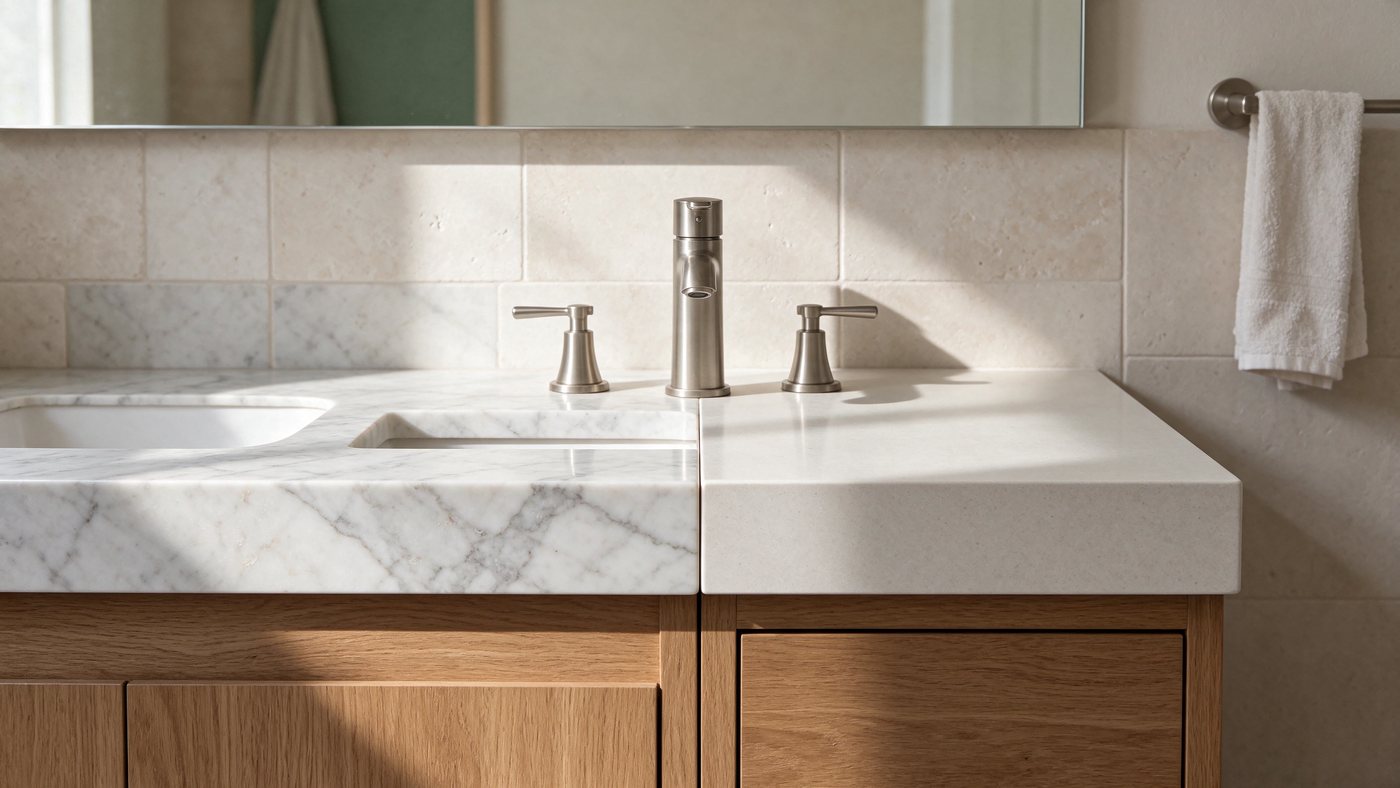
AI-generated new concept illustration; not a recovered original, actual Alya Bath product photograph, measurement, or verified depiction of any specific SKU or facility.
Compare the documented tops, not their color names
A white top with gray veining can be natural marble or an engineered surface. For example, a marble-inspired color name doesn’t establish the material. Ask for the top’s material specification before choosing a cleaner or agreeing to maintenance requirements. Engineered quartz combines stone with a binder, commonly polymer resin; it isn’t a slab of the quartz mineral alone.1 3
Vanea: a documented white quartz example
The preserved Vanea AB-VAN36-W record describes a 36-inch, white, freestanding vanity with a pure white quartz countertop and ceramic undermount sink. It lists predrilled 8-inch widespread faucet holes, an excluded faucet, brushed nickel hardware and an open back. The cabinet is described as fully assembled, with the countertop and sink attached and packed together. Compare its documented configuration through the Vanea collection and 36-inch vanity page .
“Pure white” describes the catalogue appearance, not verified resin content, stain resistance or heat limits. Request the exact top manufacturer’s care sheet rather than applying a different quartz brand’s instructions.
Norwalk and Wilmington: documented Carrara examples
The recovered Norwalk HE-101-36-G-CWMT and Wilmington HE-102-36-W-CWMT records each list a 1-inch Carrara marble top, a porcelain undermount sink and 8-inch widespread faucet holes. Both record dimensions of 36 inches wide by 22 inches deep by 34.2 inches high, with faucets and mirrors excluded. Norwalk lists soft-closing doors; Wilmington lists soft-closing doors and drawers. Their Norwalk and Wilmington pages retain the separate cabinet details.
These examples establish materials and configurations, not identical storage or installation requirements. The recovered Vanea record lacks height and depth. Don’t borrow the marble models’ dimensions to fill that gap; get a confirmed drawing for the selected model.
Separate a stain from acid etching
A dark mark under an oily cosmetic bottle and a dull patch left by vinegar need different responses. A stain changes the stone’s color; etching changes its surface. Marble contains calcium carbonate, which reacts with acidic solutions. The Natural Stone Institute explains that acids can etch the finish without leaving a stain—or cause both problems.2
This distinction matters before you buy marble. A penetrating sealer can improve resistance to absorbed stains, but it doesn’t stop the acid reaction that produces an etch. If you use vinegar to remove bathroom mineral deposits, change that cleaning habit before installing Carrara.2 4
Engineered quartz avoids marble’s calcium-carbonate etching mechanism, but that doesn’t make it immune to chemical damage. Iowa State University Extension advises avoiding bleach and harsh acidic cleaners on quartz, and cleaning up spills promptly to avoid stains.1
For either material, use a removable, easy-to-clean tray beneath grooming products. In a hypothetical shared bathroom where cosmetics stay out overnight, that tray provides a practical spill barrier. It doesn’t justify leaving spilled products indefinitely or treating either top as stain-proof.
Choose a cleaning routine you can maintain
A cleaner that works on the shower door may be unsuitable for the vanity top. For instance, an acidic limescale remover can dull marble even if you only intend to clean around the faucet. Keep a separate, clearly labeled countertop cleaner and follow the actual surface manufacturer’s directions.
For marble, the Natural Stone Institute recommends a neutral cleaner, stone soap or mild liquid dish detergent with warm water. Use a soft cloth, rinse thoroughly and dry. Too much soap can leave a film, while scouring powders may scratch the surface. For soap scum, select a non-acidic product approved for the stone rather than reaching for vinegar.2
For quartz, start with a soft cloth dampened with warm water. If residue remains, use a mild cleaner approved by the top manufacturer. Iowa State’s guidance supports prompt spill cleanup and warns against harsh chemistry; it shouldn’t be treated as approval for every household spray.1
Rinse cleaning residue away and dry around the faucet and basin rim. That makes it easier to distinguish new deposits from persistent damage. Don’t transfer a marble stain-removal recipe involving solvents to quartz, its basin adhesive or the cabinet finish. Material-specific instructions matter more than the fact that both tops look white.
Seal marble when the stone and treatment require it
A fixed resealing calendar can waste effort or leave you relying on worn protection. For example, hearing “seal every year” doesn’t tell you which treatment was applied at the factory or whether it suits your marble.
Ask the supplier what protection is already present, which compatible impregnating sealer is recommended and how to assess its condition. The Natural Stone Institute describes these treatments as repellents that improve stain resistance, not a way to make stone stain-proof. It directs owners to the supplier or sealer manufacturer for product selection and frequency.2
Iowa State describes checking marble with water to assess whether resealing is needed. If your supplier approves that check, follow its method and interpret absorption alongside the care instructions. A water check doesn’t measure acid resistance.1
Engineered quartz doesn’t require routine sealing.1 Don’t add marble sealer as an extra precaution unless the quartz manufacturer specifically calls for a treatment. Ask about the top’s finish separately; a catalogue material label doesn’t identify every coating or factory-applied product.
Inspect appearance at vanity scale
A small sample may look calm while a larger top shows a vein crossing the basin opening. If that placement matters to you, ask to see the actual marble top where possible. Natural variation means a reference photograph isn’t a promise that your piece will have the same pattern.
Engineered stone generally offers greater color and pattern consistency across slabs, but that doesn’t guarantee a perfect match between every sample and finished top.3 View the selected surface beside your cabinet finish, wall tile and basin under the bathroom’s lighting. Check the front edge as well as the top face.
Finish affects how marks look. Natural Stone Institute educational guidance notes that etching may be more noticeable on polished marble than on honed or textured marble.4 A honed finish can make some changes less conspicuous; it doesn’t prevent the underlying reaction. Confirm the supplied finish rather than assuming an Alya Bath catalogue photograph establishes it.
Discuss repair before damage happens
A chipped basin edge or persistent dull patch is a poor moment to discover that your intended repair method is unsuitable. Before purchase, ask who can assess the exact surface and what repairs may remain visible.
For etched marble, the Natural Stone Institute recommends contacting a stone dealer or professional restorer about refinishing or repolishing. It also directs deeper scratches and nicks to professional repair.2 Cleaning harder or adding sealer won’t rebuild an etched finish.
For quartz, don’t assume that a repairer can polish the affected area like marble. Engineered quartz is harder to repolish and process; the binder and manufactured finish are part of the surface you’re trying to match.3 Ask a qualified repairer to assess the top. A filled chip or repaired area shouldn’t be promised as invisible.
Keep hot styling tools off either surface and use a suitable heat-resistant rest. Direct heat can damage quartz, while the Natural Stone Institute recommends protective mats for natural stone.1 2 That modest precaution is more useful than relying on a generic temperature limit that hasn’t been verified for your top.
Get the care sheet and drawing before committing
Two vanities of the same nominal width can require different handling and plumbing preparation. The Vanea packing description, for example, says its top and sink are attached to the cabinet; that isn’t permission to lift the unit by its basin or countertop. Obtain model-specific handling instructions and use the vanity measuring workflow to check fit.
Ask for a written quote that identifies the exact vanity, top, included components and installation scope. Compare any anticipated sealing or repair costs separately rather than assuming quartz is always cheaper or marble always costs more. No current Alya Bath prices or comparative performance results are established here.
If drilling or trimming is proposed, involve a qualified fabricator. OSHA and NIOSH identify respirable silica hazards from countertop cutting, grinding and drilling, and recommend doing as much work as possible under controlled shop conditions.5 Don’t improvise a dry-cut adjustment in your bathroom.
Before approving either top, secure its care sheet and dimensional drawing. If your decision also involves other surface types or basin construction, use the broader bathroom countertop materials guide . For this two-material choice, decide whether you’re comfortable managing marble’s acid sensitivity—or would rather remove routine sealing from your care plan by choosing quartz.
Editorial disclosure: Alya Bath Editorial prepared this page from preserved catalogue records and cited material-care guidance. The September 29, 2025 display date is an assigned editorial date; actual publication is November 27, 2026.
References
- Iowa State University Extension and Outreach: Caring for Stone Countertops
- Natural Stone Institute: Care and Cleaning of Natural Stone
- Wikipedia: Engineered stone
- Natural Stone Institute educational campaign: How to Care for Your Marble Countertops
- OSHA and NIOSH: Worker Exposure to Silica during Countertop Manufacturing, Finishing, and Installation