
Alya Bath · Historical catalogue
Wilmington Marble Bathroom Vanities
A marble bathroom vanity can mean a stone countertop on a cabinet or an all-stone unit with an integrated basin. Wilmington belongs to the first group: its recovered specifications describe a freestanding cabinet, a Carrara marble top and a separate undermount sink. Its distinguishing storage feature is a display bottom shelf beneath the enclosed cabinet. 1 2
Alya Bath is a bathroom vanity manufacturer and distributor. Its preserved catalogue helps you compare Wilmington’s historical widths and finishes, then find the specifications that survive for a particular model. This page documents that catalogue. 8
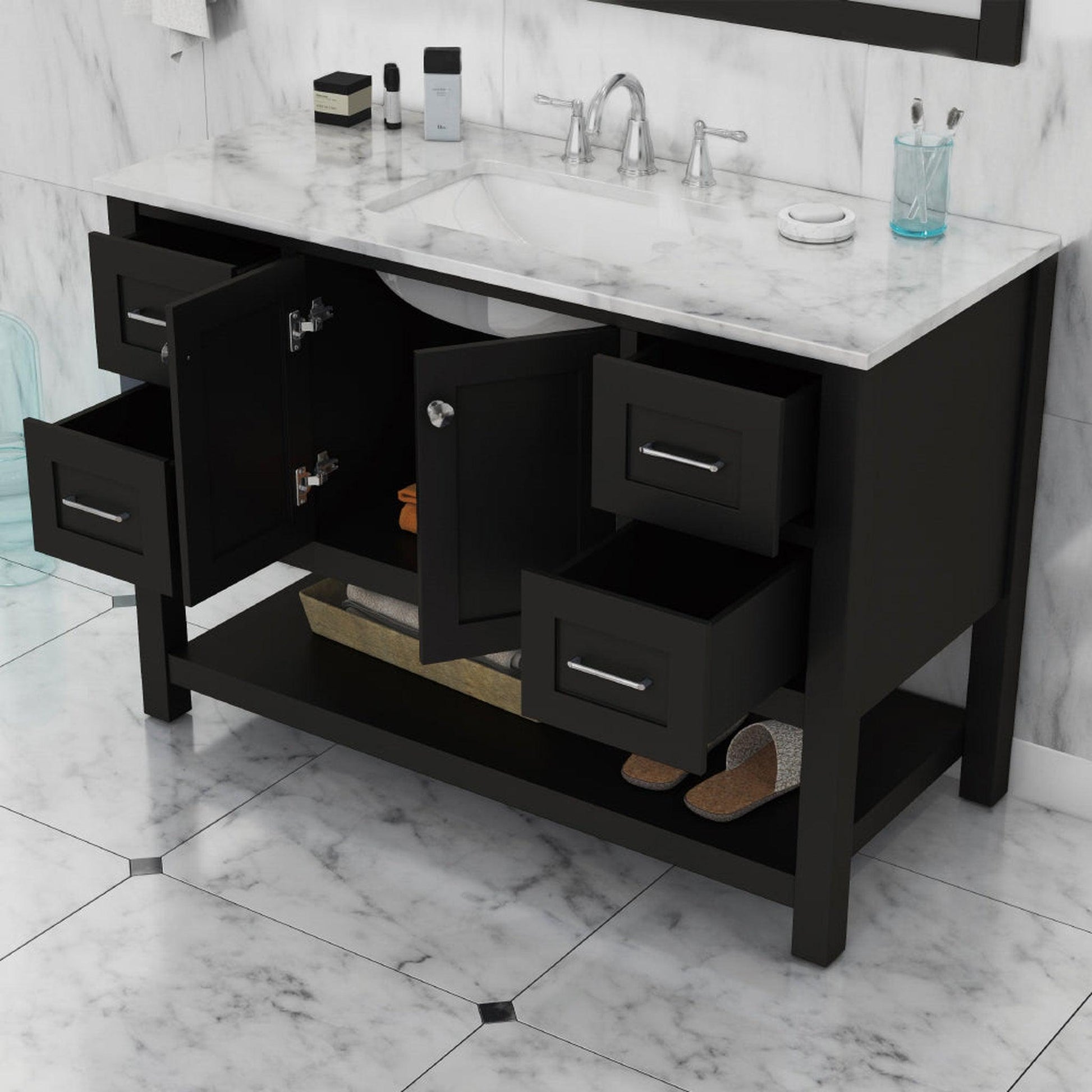
Authentic recovered Alya Bath catalogue image; historical depiction. View the preserved original image file .
Wilmington’s open shelf changes how you use the cabinet
An enclosed vanity can hide spare toiletries, but it doesn’t give you an exposed place for folded towels. Wilmington’s display bottom shelf provides that space. For example, you could keep dry guest towels on the shelf while reserving the enclosed cabinet for supplies you don’t want in view. Check the shelf opening against your intended basket or towel stack before choosing a model; no shelf dimensions or load rating are supplied in the recovered collection description. 1
Wilmington uses the HE-102 model family in its detailed records. Don’t confuse it with the Norwalk collection just because both have marble-top descriptions. The Wilmington source explicitly identifies the bottom shelf. Its collection summary also describes dovetail drawers, full-extension drawers and soft-closing glides. Those are collection-level statements, not proof that every width has the same drawer arrangement. The detailed 24-inch records list soft-closing doors, while the 36- and 48-inch records list soft-closing doors and drawers. 1 2 3 4
If you prefer everything concealed, compare cabinet layouts through the vanity styles and collections directory . If you want visible towel storage, keep Wilmington on your shortlist, but leave enough access to remove the contents and clean the shelf.
What the marble top and sink descriptions actually say
A photograph alone won’t tell you whether the basin is marble or a separate material. Wilmington’s collection summary describes an Italian White Carrara marble countertop with a ceramic sink attached to the base. The detailed 24-, 36- and 48-inch item records describe a 1-inch Carrara marble top and porcelain undermount sink. They also label the countertop material as natural stone. 1 2 3 4
Keep both source descriptions when checking a model: “ceramic” appears at collection level and “porcelain undermount” appears in the detailed item records. Ask for the exact basin specification if the distinction affects your selection. The recovered titles sometimes spell the stone “Carrera,” while the descriptive specifications use “Carrara”; this page retains Carrara for the material description without treating the title spelling as a different stone.
The detailed records list brushed nickel hardware and 8-inch widespread faucet holes. They exclude the faucet and mirror. If you’re reusing a faucet, check its mounting requirements against the top’s openings before committing to the cabinet. Use the faucet-hole spacing guide to understand the layout, then confirm hole diameters and clearances on the exact top drawing. The recovered wording does not supply those measurements. 2 3 4
Historical widths, finishes and specification links
A finish name on an old catalogue card doesn’t provide a complete installation specification. For example, a Blue Wilmington listing establishes that the name was historically used, but it doesn’t establish the cabinet’s depth or drawer count. The preserved long catalogue names Blue, Espresso, Gray and White versions at the widths below. Some have fuller HE-102 records; others survive as names-only listings. 5
24- and 30-inch listings
If your available wall space suggests a compact vanity, begin with the 24-inch specification page . The detailed Wilmington records identify Espresso HE-102-24-E-CWMT and Gray HE-102-24-G-CWMT, each listed as a single-sink, freestanding vanity measuring 24 W × 22 D × 34.2 H inches. Their feature lists specify soft-closing doors. Blue and White also appear as historical 24-inch catalogue names, but don’t inherit the Espresso or Gray specifications automatically. 2 5
The 30-inch catalogue page preserves Wilmington names in Blue, Espresso, Gray and White. No complete Wilmington 30-inch item body was recovered here. Request its own dimensions and sink arrangement rather than scaling the 24-inch record to fit.
36-inch single-sink records
If you need a documented cabinet with drawers, the 36-inch specification page brings together Wilmington Espresso HE-102-36-E-CWMT, Gray HE-102-36-G-CWMT and White HE-102-36-W-CWMT. The recovered bodies list 36 W × 22 D × 34.2 H inches, a single sink, freestanding mounting and soft-closing doors and drawers. Blue is a separate historical catalogue name without a matching full body in this recovery. 3 5
Use those measurements as recorded specifications, then check the actual top’s outside dimensions and your room’s clearances. A nominal width alone won’t show whether a drawer will meet an adjacent door casing.
48-inch single-sink records
If you want a wider single-basin layout, review the 48-inch specification page . Gray HE-102-48-G-CWMT and White HE-102-48-W-CWMT have detailed records listing 48 W × 22 D × 34.2 H inches and soft-closing doors and drawers. Blue and Espresso appear as separate historical 48-inch single-vanity names, without equivalent full specifications in the supplied records. 4 5
Don’t assume that the added width establishes a particular amount of usable counter space. The basin position and dimensions are needed to answer that question.
60-inch single and double; 72-inch double
A shared bathroom may need two basins, while another room may benefit from one. The historical Wilmington catalogue names 60-inch single-sink and 60-inch double-sink versions in Blue, Espresso, Gray and White. It also names 72-inch double-sink versions in those same finishes. These remain distinct historical choices, not interchangeable models. 5
Use the 60-inch single-sink page , 60-inch double-sink page and 72-inch catalogue page to compare the preserved evidence. Wilmington’s full dimensions, exact SKUs and door or drawer counts weren’t recovered for these listings. Don’t extend the 22-inch depth or 34.2-inch height from the smaller HE-102 records to them.
Resolve cabinet construction and assembly before installation
A material description can change what you expect to see inside the cabinet. Wilmington’s collection summary says 100 percent solid hardwood, but its detailed item bodies say solid and hardwood plywood. Those descriptions conflict. Ask which components are solid hardwood and which are plywood for the exact model; the recovered wording doesn’t establish an all-solid cabinet. 1 2 3 4
Assembly wording also needs confirmation. The collection says the vanity comes fully assembled with the marble top and ceramic sink attached to the base. The item records say “minimal assembly required” and identify a finished cabinet. Don’t interpret either statement as completed bathroom installation. Confirm how the cabinet, top and basin are supplied, and obtain the mounting and plumbing instructions before planning the work. 1 2 3 4
The vanity measuring guide can help you record the room and existing plumbing. Match those measurements to the exact Wilmington drawing, especially where the drain or supply lines could interfere with storage.
Choose marble with a realistic cleaning routine
A dull patch beside the faucet may be surface etching rather than dirt that needs stronger cleaner. The National Park Service’s Preservation Brief 1, published in November 2000, identifies polished and unpolished marble as acid-sensitive stone. The Natural Stone Institute warns that lemon, vinegar and other acids can dull or etch calcareous stone. Don’t use a vinegar-based cleaner on Wilmington’s marble top. 6 7
For routine care, the Natural Stone Institute recommends a neutral cleaner, stone soap or mild liquid dishwashing detergent with warm water, followed by thorough rinsing and drying with a soft cloth. Blot spills promptly. A tray under toiletries can help contain drips, but it doesn’t replace cleaning the top. 6
Sealing is not a stain-proof guarantee. The institute advises confirming whether sealing is needed and following the supplier’s recommendations for the product and frequency. If you notice an etched area, consult a stone professional rather than repeatedly scrubbing it. For a material comparison, read quartz versus marble countertops ; for ongoing maintenance, use the vanity care guide . 6
Before specifying Wilmington, send the historical model name, width, finish and known HE-102 code to support@alyabath.com . Request the matching drawing, cabinet composition, basin details and assembly instructions. For a names-only model, ask for its exact SKU first; that prevents a specification from a different width or finish being used by mistake.
References
- Alya Bath preserved Wilmington collection description
- Alya Bath preserved Wilmington HE-102-24-G-CWMT record
- Alya Bath preserved Wilmington HE-102-36-W-CWMT record
- Alya Bath preserved Wilmington HE-102-48-G-CWMT record
- Alya Bath preserved historical vanity catalogue
- Natural Stone Institute Care and Cleaning of Natural Stone
- National Park Service Preservation Brief 1, November 2000
- Alya Bath preserved Wilmington portfolio and company description