
Alya Bath · Planning and advice
3 Popular Bathroom Vanity Materials to Consider
Published: · Updated:
Solid wood, medium-density fiberboard and plywood are common bathroom vanity materials, but none is a promise of waterproof construction. Choose solid wood for the natural grain you want to see, consider MDF for a smooth painted or veneered surface, and look at plywood for dimensionally stable cabinet panels. Then compare the actual cabinet specification, your budget and the water exposure in your bathroom.
Alya Bath is a bathroom vanity manufacturer and distributor serving resellers and trade professionals. Its recovered vanity catalogue helps show why material names need context: older Ripley records describe MDF with wood veneer, while Norwalk records include solid-wood and hardwood-plywood wording. These are historical descriptions, not confirmation of a currently supplied cabinet’s construction.
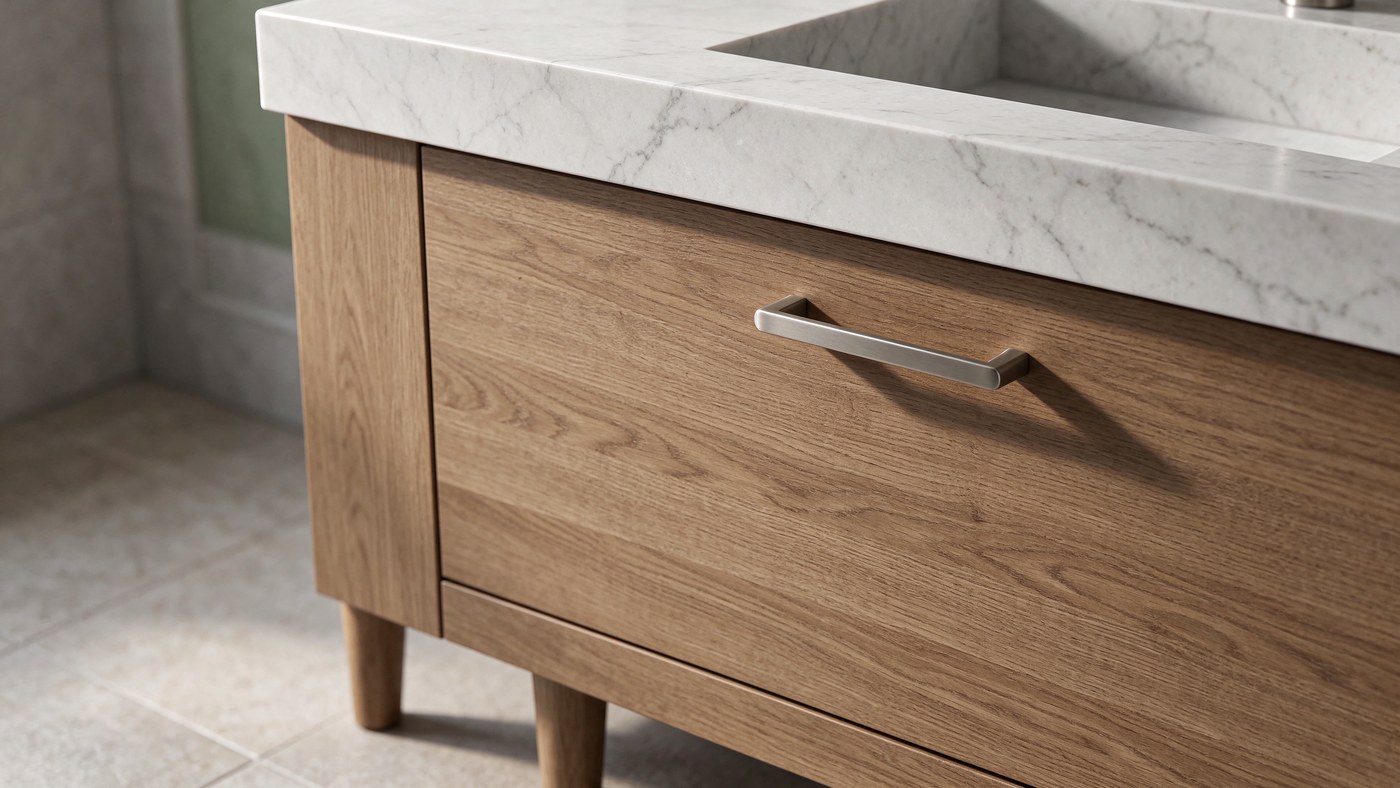
AI-generated new concept illustration; not a recovered original, actual Alya Bath product photograph, measurement, or verified depiction of any specific SKU or facility.
Separate the cabinet material from its finish and top
A wood-grain vanity can be misleading if you’re trying to identify what’s underneath. For example, a thin decorative wood veneer can cover MDF; visible grain doesn’t prove the cabinet is solid lumber. The USDA Forest Products Laboratory describes both veneered fiberboard and decorative plywood in its 2021 Wood Handbook. 1
Ask what the cabinet sides, bottom and doors are made from, rather than accepting one material label for the whole vanity. A cabinet can combine different materials for different parts. Paint and veneer describe the visible surface; they don’t establish the core underneath.
The countertop and basin are separate choices. A marble top tells you nothing about the cabinet’s composition or water resistance. Use the bathroom countertop materials guide for that decision, so you can compare cabinet construction here without mixing in stone and sink performance.
1. Solid wood: natural grain with moisture movement
If you want visible natural wood, a painted or printed surface may not give you the variation you’re looking for. Solid lumber offers real grain, but selecting it solely because it sounds more durable can overlook the bathroom’s conditions.
Wood gains and loses moisture as the surrounding air changes. It can swell and shrink, with movement varying by species and grain direction. A wide solid-wood panel may therefore move differently from a narrow frame component. The USDA’s 2021 moisture chapter explains that protective coatings slow moisture exchange but don’t prevent it. 2
Choose solid wood when its appearance matters to you, and confirm that the completed vanity is intended for bathroom use. Don’t assume it will warp after every shower, or that it can withstand a persistent leak. Construction and moisture management affect the result.
Solid-wood vanities can cost more than engineered-panel alternatives, but compare actual quotes for comparable sizes and included components. A higher price alone doesn’t establish better construction. For maintenance, follow the instructions for the factory finish; the phrase “solid wood” doesn’t tell you to oil or reseal the cabinet on a fixed schedule.
Alya Bath’s Norwalk collection illustrates a specification question worth resolving. The recovered collection description says “100 percent solid hardwood,” while individual product records say “Solid and Hardwood Plywood.” Confirm the component materials for your selected model rather than treating those descriptions as interchangeable. The solid-wood vanity cabinet guide covers the more detailed construction questions.
2. MDF: a uniform surface, with water-exposure limits
If you’re comparing smooth painted vanities on a limited budget, MDF can be a useful option. A uniform door surface may matter more to you than visible grain, but a good-looking finish doesn’t remove the need to understand the panel underneath.
MDF means medium-density fiberboard. It is made from wood fibers combined with resin and formed into panels under heat and pressure. Wood residuals can be used in its manufacture; the name alone doesn’t verify a particular cabinet’s recycled content. Its smooth, grain-free surface accepts paint and veneer well. 1 3
MDF vanities may offer a lower purchase cost than comparable solid-wood designs. Keep that as a possibility to check, rather than a fixed price rule. Alya Bath’s older Ripley AT-8041 records , for example, describe an MDF/wood-veneer cabinet. Veneer supplies the visible wood surface without making the underlying panel solid wood.
The limitation is water reaching the panel. MDF can swell, and unsealed panels may expand or warp in humid conditions. Grades and resin systems differ, so a moisture-resistant product shouldn’t be treated as equivalent to standard MDF—or as waterproof. 1 3
For a powder room with occasional splashes and no shower, bathroom-suitable MDF may fit your priorities. For a cabinet beside frequent splashing, be more cautious about the specified grade and exposed surfaces. There’s no sound universal rule that MDF is more durable or less prone to warping than every solid-wood vanity. Compare the intended application and protect the finished cabinet from standing water.
3. Plywood: stable panels, but not automatic water protection
If you want a wood-based cabinet box that stays dimensionally stable, plywood deserves consideration. For example, broad cabinet side panels benefit from plywood’s layered construction, but the word “plywood” still leaves questions about quality and exposure suitability.
Plywood consists of thin wood veneers bonded together, with adjacent layers generally oriented across one another. The USDA Wood Handbook describes good stability along the panel’s length and width. It also explains that performance depends on the veneers, adhesive and manufacturing conditions. 1
That makes plywood a useful cabinet-panel choice, rather than proof that every plywood vanity is superior. Decorative hardwood plywood includes different core constructions and bond classifications. A cabinet described as hardwood plywood shouldn’t be assumed to use an exterior-rated adhesive. 1
Ask for the supplied model’s material specification and suitability for the expected bathroom conditions. Keep leaks and wet cleaning water away from the cabinet, even if the plywood has a water-resistant bond. The wood and finished assembly still need protection.
Plywood can cost more than some MDF options, but it isn’t inherently an expensive or high-maintenance vanity choice. Compare the complete cabinet and its finish. Installation effort depends on the vanity’s assembly and mounting arrangement, not just the panel material. Don’t pay extra based on a claim that plywood is automatically easier to install.
Match your choice to the moisture problem you can control
A bathroom that stays damp after showers has a different problem from a cabinet with a dripping drain connection. Buying a different material won’t fix either source of moisture.
For shower humidity, use effective ventilation. Pacific Northwest National Laboratory explains that bathroom exhaust fans remove moisture and help reduce relative humidity and condensation. EPA advises running the bathroom fan or opening a window while showering. Persistent condensation is a reason to review ventilation before installing new cabinetry. 4 5
For splashes or leaks, wipe water up promptly and fix the source. A wet bottle stored under the sink can keep a small area damp even when the room feels dry. EPA recommends repairing plumbing leaks as soon as possible and drying affected items completely. 5 The vanity care guide explains ongoing cabinet and leak checks in more detail.
Before requesting a vanity quote, identify the cabinet material separately from the finish, then confirm what the price includes. Keep room in the project budget for unresolved plumbing or ventilation work. If an Alya Bath description leaves the cabinet composition unclear, email support@alyabath.com with the model code and the conflicting wording. A component-specific answer is more useful than a general promise that a vanity is “durable.”
Editorial disclosure: Alya Bath Editorial has updated this recovered article with independent materials references. Catalogue examples come from preserved Alya Bath records.
References
- USDA Forest Products Laboratory, Wood Handbook Chapter 11: Wood-Based Composite Materials, 2021
- USDA Forest Products Laboratory, Wood Handbook Chapter 4: Moisture Relations and Physical Properties of Wood, 2021
- Wikipedia: Medium-density fibreboard
- Pacific Northwest National Laboratory: High-Efficiency Bathroom Fans
- EPA: A Brief Guide to Mold, Moisture and Your Home