
Alya Bath · Planning and advice
Solid-Wood Bathroom Vanity Cabinets: Materials, Joints and Moisture
Published: · Updated:
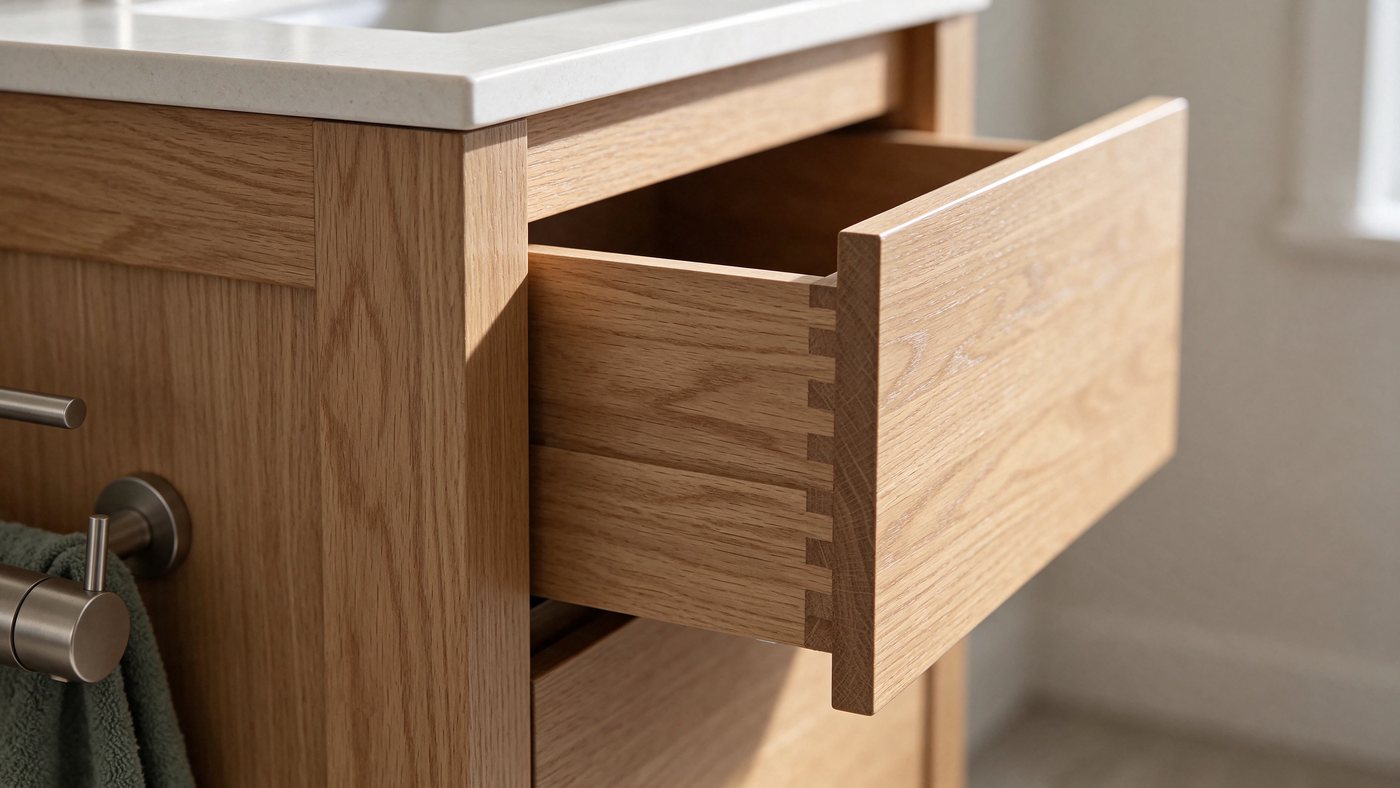
A solid wood bathroom vanity can be a good choice, but the label alone doesn’t tell you how its cabinet is built. A solid-wood door may sit on a plywood box, while a convincing wood-grain front may be veneer over MDF. Before you choose, ask which components are solid wood, how they’re joined and where water could reach an unfinished edge.
Alya Bath is a bathroom vanity manufacturer and distributor whose preserved catalogue provides useful examples of these specification questions. We’ll use its records to show what you can establish from a description—and what still needs confirmation. For a shorter comparison of the main materials, see 3 Popular Bathroom Vanity Materials to Consider .
Illustration disclosure: AI-generated new concept illustration; not a recovered original, actual Alya Bath product photograph, measurement, or verified depiction of any specific SKU or facility.
Ask for a component map, not a material slogan
A listing that says solid wood may leave the drawer bottoms and cabinet back unexplained. For example, solid-wood face frames and doors don’t establish the composition of the side panels. Ask for a written material breakdown tied to the model and finish you’re considering.
The breakdown should identify the frame, doors, drawer fronts, drawer boxes, drawer bottoms, sides, shelves, base and back. Request panel thicknesses and the solid-wood species too. Those details let you compare equivalent parts rather than treating every wood-looking cabinet as the same construction.
Separate the surface from the core
A veneered panel has a thin layer of real wood attached to a substrate; it isn’t necessarily solid wood through its thickness. Plywood uses veneer layers with alternating grain directions. That construction reduces movement across the panel compared with solid wood, although performance still depends on the core, adhesive and manufacturing quality. Hardwood plywood can have different core constructions, so ask what lies beneath its face veneer. 2
MDF, or medium-density fiberboard, is made from wood fibers bonded with resin and pressed into panels. A decorative laminate is a surface layer, not a description of the cabinet’s core. Melamine-based decorative surfaces and wood veneers can both cover engineered panels. Neither a wood-grain pattern nor a smooth painted finish identifies the substrate. 2
Don’t automatically reject plywood in a cabinet box. Instead, ask for its core and intended moisture exposure. For MDF, request the grade and any moisture-resistance documentation. A coating cannot make an unsuitable exposed core safe from an ongoing leak; moisture-resistant composites still need protection from wetting. 2 4
Choose solid wood with movement in mind
A broad cabinet door that fits during delivery may rub later if humidity changes. Wood exchanges moisture with the surrounding air and expands or contracts as its moisture content changes. Movement is much greater across the grain than along it, and the amount varies with species and grain orientation. 1
Ask how the door construction accommodates that movement. A framed solid-wood panel needs an appropriate allowance within its assembly; a wide panel shouldn’t be treated as dimensionally fixed. Don’t fill an intentional panel clearance or demand that every joint disappear beneath rigid filler. Have the supplier explain the design before altering it.
Species names help you compare appearance and physical properties, but they aren’t a bathroom suitability guarantee. USDA’s 2021 Wood Handbook describes how density, grain and porosity influence finishing and movement. A harder or denser wood isn’t automatically the most stable choice. 4
For a stained cabinet, inspect the actual finish sample for grain and color variation. For a painted cabinet, look closely at panel edges and frame joints. Request model-specific storage and conditioning instructions rather than assuming every cabinet needs the same acclimation period.
Inspect the joints beyond the dovetail label
A dovetail drawer can still disappoint if its bottom is loose or its runners bind. The joint name describes one connection, not the performance of the complete drawer.
Dovetails use interlocking shapes at a corner. Other cabinet connections may use dowels, mortise-and-tenon joints, rabbets or dados. USDA identifies several such geometries as useful ways to connect wood; bond performance also depends on sound surfaces, fit, adhesive and assembly conditions. A properly made dowel joint isn’t automatically inferior because it lacks a dovetail profile. 3
With permission, open each drawer and inspect the accessible corners. Look for separation, cracked wood or a bottom that has slipped from its support. Operate the drawer through its available travel without forcing it. Check that the front stays aligned and that the soft-close mechanism engages consistently.
Soft-close hardware controls closing motion. It doesn’t prove the cabinet’s joint strength, load capacity or moisture resistance. Ask separately about drawer-bottom construction, runner attachment and the specified loading limits. Don’t perform an improvised load test on an undocumented cabinet.
Check the edges water can reach
A smooth front can hide a bare cutout inside the sink cabinet. Plumbing holes, bottom edges and joints near the countertop deserve attention because they’re close to potential leaks and repeated splashes.
USDA explains that finishes slow moisture exchange rather than stopping it. End grain takes up liquid water faster than side grain, which makes protection of exposed board ends especially useful. 4
Before installation, inspect accessible bottom edges, door edges, panel seams and plumbing openings. Look for exposed core material, chipped paint, lifting edge banding or gaps in the coating. Ask which surfaces are factory finished and how the installer should protect any new cut edges.
Don’t choose a sealant by guessing from the cabinet color. The repair material must suit the substrate and existing coating. Follow the cabinet and top instructions for their interface, and keep intended service openings accessible. Edge sealing supplements good plumbing and moisture control; it cannot compensate for water repeatedly collecting inside the cabinet.
Use Alya Bath records as specification examples
A collection description and an individual model sheet can disagree. That’s a reason to request clarification before selection, rather than choosing whichever claim sounds better.
The recovered Vanea AB-VAN36-G record describes solid-wood construction, a moisture-resistant coating, dovetail drawers and soft-closing doors and drawers. It also records an open back, a white quartz top and a ceramic undermount sink. See the Vanea collection and its preserved 36-inch specifications . 5
Those details support questions about construction, but the record doesn’t identify the wood species, component-by-component materials or a coating test. Moisture-resistant wording isn’t evidence of waterproof performance or environmental certification.
The recovered Norwalk collection and Wilmington collection descriptions present their construction as entirely solid hardwood. Their gray 36-inch product records—HE-101-36-G-CWMT and HE-102-36-G-CWMT—mix solid-wood and hardwood-plywood wording instead. The component allocation remains unresolved. 5 6 7
Request a current model-specific material sheet before treating either family as all-solid-wood construction. These are documented catalogue examples, not a claim about every model in a collection.
Treat coating damage as an inspection trigger
A chip beside a sink may look cosmetic, but it can expose material to repeated wetting. Water entering beneath a damaged finish can cause localized swelling and further coating failure. 4
Photograph the damage and identify its likely source before repair. Dry splashes promptly, stop any leak and ask for a compatible repair method. If an edge is swollen, a veneer is lifting or a joint has opened, have the damage assessed before covering it with paint. Touch-up color doesn’t establish that the underlying material is sound.
Don’t paint or caulk over mold. EPA advises fixing the water problem, removing mold appropriately and drying the surface before painting. Suspected hidden mold or contaminated-water damage calls for professional assessment. 8 For cleaning and hardware routines, use the separate bathroom vanity care guide .
Plan moisture control before handover
Even a carefully finished cabinet can suffer beside a leaking trap or in a bathroom that stays damp. For example, bottles under the sink can conceal a slow drip until the base is wet.
Keep plumbing connections visible enough to inspect, and have the installer check for leaks after filling and draining the basin. Wipe cabinet splashes promptly and avoid leaving wet cloths against doors. EPA recommends exhausting bathroom moisture outdoors, not into the attic. 9
EPA’s moisture guide, accessed in 2026, recommends keeping indoor relative humidity below 60%, ideally 30–50% where possible. These are general moisture-control targets, not proof that a cabinet will tolerate every bathroom condition. Its advice to dry water-damaged materials within 24–48 hours concerns mold prevention; don’t treat that interval as a damage-free allowance for wood or MDF. 8
Before accepting the cabinet, keep a short handover record:
- Match the model and finish to the written component specifications.
- Photograph existing coating damage and accessible unfinished edges.
- Check door and drawer operation after the cabinet is supported and fixed.
- Record any cut-edge protection and unresolved material questions.
- Obtain the applicable care and repair instructions.
If the material sheet still doesn’t say what the cabinet sides and base are made from, leave that question open and ask for confirmation. A documented component specification is more useful than another repetition of the solid-wood label.
References
- USDA Forest Products Laboratory: moisture relations and physical properties, 2021 .
- USDA Forest Products Laboratory: wood-based composite materials, 2021 .
- USDA Forest Products Laboratory: wood adhesives and bonded joints, 2021 .
- USDA Forest Products Laboratory: finishing wood, 2021 .
- Alya Bath: preserved 36-inch Norwalk, Wilmington and Vanea model records .
- Alya Bath: recovered Norwalk collection description .
- Alya Bath: recovered Wilmington collection description .
- EPA: A Brief Guide to Mold, Moisture and Your Home .
- EPA: controlling moisture in your home, updated February 18, 2026 .