
Alya Bath · Planning and advice
Acrylic Bathroom Sinks: Five Benefits and Limits
Published: · Updated:
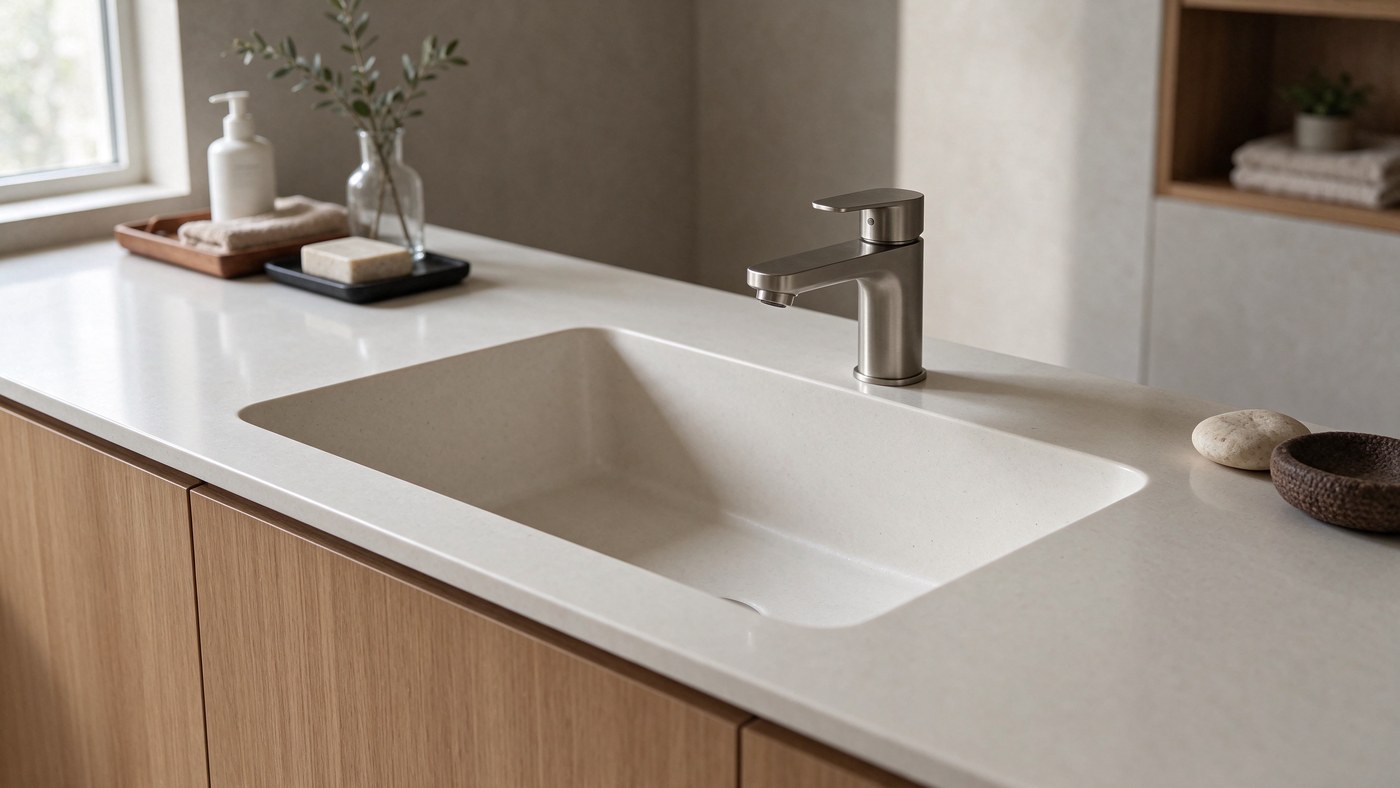
An acrylic bathroom sink can be a practical choice if you want a basin that flows directly into the vanity top and is straightforward to wipe down. The trade-off is care: acrylic-based surfaces can scratch, and their resistance to heat or chemicals depends on the product. A white surface that looks clean in a photograph doesn’t tell you how it will handle your hair products or cleaning routine.
Alya Bath is a bathroom vanity manufacturer and distributor serving resellers and trade professionals. Its recovered Ripley catalogue includes acrylic resin countertops with integrated sinks, so this is a material choice with a documented connection to the brand. When comparing bathroom vanity countertop materials, those records help us assess complete basin-and-top assemblies rather than treat every white vanity top as the same material.
Integrated acrylic or a separate basin and top?
A listing that says “resin sink” can leave you unsure what you’re buying. For example, a molded basin-and-top assembly and a stone countertop with an undermount ceramic bowl may look similar from above, but their joints and replacement options differ.
In an integrated design, the bowl and surrounding top form a continuous assembly. Alya’s recovered AT-8006-W record describes an acrylic resin countertop with an integrated sink; the 24-inch vanity page retains that model’s details. The Ripley AT-8048-W record describes a one-piece integrated acrylic resin double basin. This arrangement avoids a separate bowl-to-countertop rim joint, although the drain, faucet openings and wall junction still need attention.
“Solid surface resin” is a broader description. Solid-surface materials commonly combine mineral filler with resin and pigments, and the resin can be acrylic, polyester or another type. 1 Alya’s Sortino AB-MD684-RW uses that broader label. It doesn’t establish the same composition as a Ripley acrylic top. Ask for the exact material and whether there’s a separate surface coating before choosing cleaners or considering repairs.
For comparison, recovered Norwalk records pair Carrara marble with an undermount basin, while Vanea records pair white quartz with a ceramic undermount basin. A separate bowl may offer a different replacement route, subject to its cutout and mounting access. An integrated assembly may require replacing the whole top if a damaged bowl can’t be repaired. Keep that distinction in view; the broader bathroom countertop materials guide covers the other material choices.
1. Durability is useful, but scratch resistance has limits
Daily use can include more than running water. Sliding a metal grooming tool across the basin edge or scrubbing toothpaste with a rough pad puts the surface under a different kind of stress.
Acrylic-based solid surfaces offer useful repair potential, and their nonmetallic construction avoids rust in the basin material itself. That doesn’t protect metal drains or hardware, and it doesn’t make the top scratch-proof. The Canadian Conservation Institute warns that abrasive cleaners can scratch acrylic sheet. Its guidance concerns display cases rather than bathroom sinks, but it directly contradicts the idea that acrylic cannot be scratched. 2
Use a soft cleaning cloth and keep sharp tools off the top. Place hot styling tools on a suitable heat-resistant holder rather than on the basin edge: solid surface is described as moderately heat resistant, not immune to heat damage. 1 Don’t assume a repair video applies to your sink. Some solid surfaces are repairable, but a supplier needs to confirm whether sanding or polishing is suitable for your particular material and finish.
2. A nonporous surface helps cleaning; it isn’t antibacterial
A toothpaste film can remain on a smooth basin even if the material beneath it is nonporous. If you leave that film in place, the sink still needs cleaning; the material description doesn’t remove the residue for you.
Nonporous solid surface is a useful feature because its material structure doesn’t have the open pores associated with absorbent surfaces. 1 It doesn’t follow that every dye or cleaner is harmless, or that bacteria can’t remain on the surface. Treat “nonporous,” “stain resistant” and “antibacterial” as different claims rather than interchangeable descriptions.
For routine hygiene, remove visible residue with a compatible cleaner. The CDC explains that cleaning with soap or detergent removes dirt and most germs, and that cleaning should come before disinfection. 3 Even an antimicrobial treatment that protects a product doesn’t automatically protect its users from disease organisms, as EPA guidance on treated articles explains. 4 No such treatment or public-health protection has been verified for the Alya basins discussed here.
If you use hair dye at the vanity, check the basin’s care instructions before bringing it into contact with the surface. Keep the container on a protective tray and address spills promptly rather than rely on an unsupported no-stain promise.
3. Everyday cleaning can be straightforward, with product-specific rules
A familiar bathroom spray may be the wrong choice for a new sink. For example, a cleaner that works on your mirror can contain ingredients that aren’t suitable for an acrylic surface.
Start with the basin supplier’s care instructions. For routine dirt, use a soft cloth with mild soap and water if that method is approved, then rinse away residue and dry the surface. The CDC recommends soap and water or an appropriate cleaning product for hard surfaces. 3 A gentle routine gives you a starting point without assuming every household cleaner is compatible.
Avoid abrasive powders and scouring pads unless the product’s instructions expressly permit them. The Canadian Conservation Institute also cautions that some solvents can cause fine surface cracks, called crazing, in acrylic sheet. 2 That isn’t a basin-specific compatibility test, so don’t use its display-case solvent or polishing suggestions as a sink repair recipe.
If someone in your home is sick or at increased risk of illness, CDC guidance calls for disinfection as well as cleaning. Choose a disinfectant that is compatible with the basin, follow its label contact time and never mix cleaning chemicals. 3 If the material guidance and disinfectant label don’t provide a workable method, ask the supplier before proceeding. The vanity care guide helps separate basin care from cabinet and hardware maintenance.
4. Finish variety exists, but cabinet color isn’t sink color
A vanity listed as Black or Rosewood doesn’t necessarily have a black or woodgrain sink. That distinction matters if you’re trying to match the top to existing tile or fixtures.
Solid-surface materials as a category come in varied colors and patterns. 1 The recovered AT-8006-W and AT-8048-W records specify white acrylic tops and sinks. The Sortino AB-MD684-RW record describes a Rosewood cabinet with a white solid-surface resin sink.
Check the top finish and cabinet finish separately. Request a sample or a verified photograph of the exact model if the shade matters to your design. Ask about the surface sheen, too; a generic photograph cannot reliably establish whether the actual basin is glossy or matte. The original article’s matte-black and woodgrain examples aren’t verified finish specifications, so don’t plan a room around those descriptions.
5. Cost can be a benefit, but compare complete installed options
A lower headline price can hide a different scope of work. For example, a ready-made integrated top and a custom-cut marble top with a separate bowl aren’t comparable until you know what each quote includes.
Keep affordability as a buying question rather than a promise that acrylic is always cheaper than granite or marble. Obtain quotes for the same vanity width and basin arrangement, with the faucet layout specified. Include delivery, fitting, drain components, removal of the old top and any plumbing changes. Ask whether the top needs fabrication or arrives ready to fit the stated cabinet.
An integrated assembly may avoid ordering a separate bowl and its mounting components, but that doesn’t establish a lower installed total. Future repairs matter as well: ask whether damage can be repaired locally, whether replacement requires the complete top, and what documentation identifies the correct replacement. No current Alya prices are verified here. A quote with a clear scope is more useful than a generic material price range.
Confirm the top before committing to the vanity
A suitable material can still be the wrong assembly for your bathroom. An existing widespread faucet, for example, won’t automatically fit a top documented for single-hole installation.
Recovered Ripley acrylic records specify single-hole faucet openings; the Norwalk and Vanea examples above specify 8-inch widespread layouts. Use the faucet-hole spacing guide to check the planned faucet against the exact top drawing. Don’t assume you can drill a molded basin assembly without written instructions.
Check actual dimensions as well as the name on the listing. The AT-8048-W title says nominal 48 inches, while its recovered specification lists 47 inches wide. That source difference needs confirmation, not rounding. Follow the vanity measuring guide and request a current drawing for the intended model.
Before you approve the choice, get two things in writing: the assembly’s material and finish specification, and its cleaning instructions. Those documents tell you whether the integrated basin suits your daily routine—and how to care for the actual product rather than a generic idea of acrylic.
Editorial note: Alya Bath Editorial has updated this historical article while preserving its five original topics. Unsupported scratch-proof, stain-proof, hygiene, finish and price claims have been replaced with qualified guidance. The page image is an AI-generated new concept illustration, not a recovered original, actual Alya Bath product photograph, measurement or verified depiction of a specific SKU or facility.