
Alya Bath · Planning and advice
Bathroom Faucet Hole Spacing: Single Hole and 8-Inch Widespread
Assigned editorial date:
Actual published: · Updated:
This is a newly written post. Its assigned editorial date is not evidence of past publication.
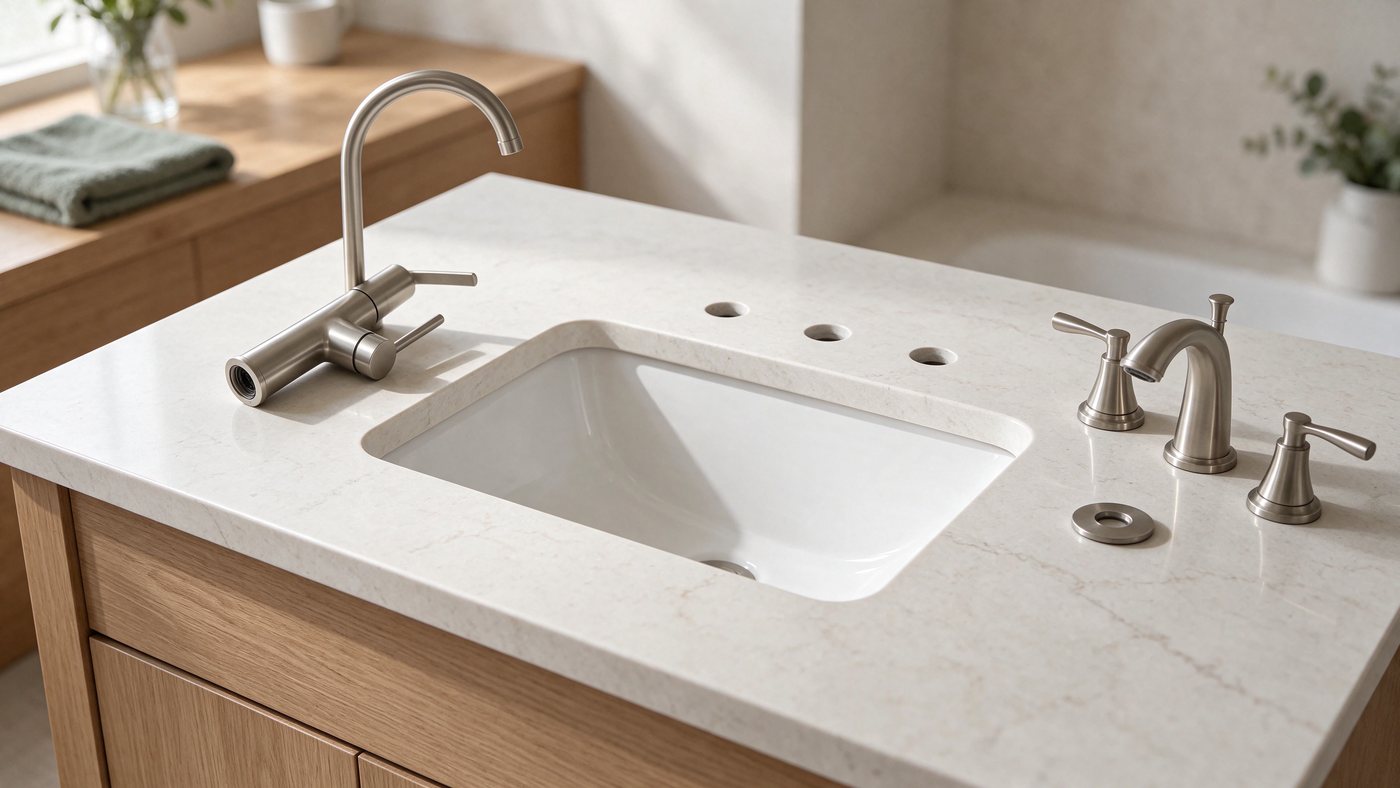
Bathroom faucet hole spacing is measured center to center, not from the edges of the openings. For an 8-inch widespread layout, the measurement runs between the centers of the two outer mounting holes. A single-hole top has no spread to measure, but you still need to confirm that the faucet fits the opening, clamps to the deck and reaches into the basin.
Alya Bath manufactures and distributes bathroom vanities for resellers and trade professionals. Its recovered catalogue gives us useful examples of both mounting patterns: Ripley records specify single-hole installation, while documented Norwalk, Wilmington and Vanea records specify 8-inch widespread holes. Those labels help you narrow your faucet choice; they don’t establish every installation dimension. 1
Measure the holes, not the faucet’s overall width
An existing faucet can hide the openings beneath its bases. For example, measuring across two broad handle bases gives you their outside width, not the mounting spread. Use visible component centers for a preliminary check, then confirm the actual holes against the sink or top drawing before selecting a replacement.
When the openings are exposed, count them and measure along the line through their centers. On a conventional three-hole widespread arrangement, the middle opening takes the spout and the outer openings take the separate valves. Record the distance between the two outer centers. Also record each outer hole’s position relative to the middle hole; the overall spread alone won’t reveal an offset middle opening.
Don’t remove a connected faucet just to get a better tape-measure reading without preparing for the plumbing work. Have the installer isolate the water supply and safely disconnect it if removal is needed. Michigan State University’s plumbing fixture specification requires compatible component combinations and coordination of faucet inlets with fixture holes. That is the useful principle here: compare actual dimensions rather than assuming a style name guarantees a fit. 2
A checked 8-inch measurement example
Suppose an exposed top has hole centers at 2 inches, 6 inches and 10 inches along the same ruler. These are hypothetical measurements, not dimensions for an Alya Bath model.
- The outer-hole spread is 10 − 2 = 8 inches.
- The left-to-middle distance is 6 − 2 = 4 inches.
- The middle-to-right distance is 10 − 6 = 4 inches.
The result is an 8-inch outer spread with a centered spout hole. It isn’t a 4-inch centerset layout just because adjacent holes are 4 inches apart. Keep the outer-center measurement on your worksheet so you don’t compare the wrong number with the faucet specification.
Match the mounting pattern before choosing the finish
A faucet may look right beside a vanity but require a different set of openings. For example, a deck-mounted widespread faucet needs separate mounting positions for its spout and valves; it can’t use a top documented only for single-hole mounting without an approved change to that top.
For a single-hole record, look for a faucet whose installation drawing specifies that mounting arrangement. “Single-hole” describes the mounting requirement, not necessarily the number of handles. For an 8-inch widespread record, confirm that the selected faucet explicitly permits an 8-inch center-to-center spread. Don’t assume every faucet labeled widespread has the same permitted installation range.
A three-hole 4-inch centerset faucet is a different mounting arrangement. Hole count alone therefore isn’t enough: a three-hole top and a three-hole faucet can still be incompatible. Compare both the opening pattern and the dimensions shown in the faucet instructions.
This article doesn’t establish a cover plate, conversion kit or alternate drilling option for any Alya Bath vanity. If you want to change mounting types, get written confirmation for the exact top and faucet combination before buying or modifying anything.
Use the Alya Bath records as specific examples
Two vanities of similar width can require different faucets. The documented 24-inch examples below show why you should read the exact model record rather than choose by cabinet size or countertop color.
Ripley AT-8006: single-hole mounting
The Black Ripley record, code ALYA-AT-8006-B, describes a wall-mounted cabinet with a white acrylic resin countertop and integrated sink. It expressly lists single-hole faucet openings and Single-Hole installation. A pop-up drain assembly is included in the record; the faucet isn’t. Its recorded overall dimensions are 23.5 inches wide by 18.75 inches deep by 21 inches high, despite the nominal 24-inch title. None of those overall dimensions gives you the faucet hole diameter or its distance from the basin. 5
Use the 24-inch vanity comparison to keep this wall-mounted model separate from other 24-inch records. Request a model-specific top drawing for the opening size and position. Don’t use the cabinet depth as a substitute for spout reach.
The recovered Ripley AT-8048-W double-vanity record also specifies single-hole mounting. Its preserved specification PDF contains drawings labeled AT-8048 and AT-8048-D, rather than an unambiguous AT-8048-W drawing. Confirm the applicable revision before using its dimensions for a faucet purchase; this guide does not transfer a hole diameter from that document to the W record. 9
Norwalk and Wilmington: documented 8-inch widespread holes
The Gray Norwalk HE-101-24-G-CWMT record specifies 8-inch widespread faucet holes, a 1-inch Carrara marble top and a porcelain undermount sink. The Gray Wilmington HE-102-24-G-CWMT record separately lists those same faucet and top details. Both records give overall dimensions of 24 inches wide by 22 inches deep by 34.2 inches high and exclude the faucet. 6 7
These are distinct collections, not interchangeable model names. Check the Norwalk collection or Wilmington collection for the record you’re considering. The 8-inch label supports a spread check, while the recorded marble thickness prompts a separate check of the faucet’s permitted mounting thickness.
Vanea: 8-inch spread on a quartz top
The Gray Vanea AB-VAN24-G record describes a white quartz countertop with predrilled 8-inch spread faucet holes and a ceramic undermount sink. Its attributes identify the faucet type as 8 Inch Widespread, and the faucet is excluded. The record also describes an open-back cabinet with the countertop and sink attached and packed with it. It does not provide a quartz thickness or hole diameter. 8
For this Vanea collection example, don’t borrow the 1-inch marble thickness from Norwalk or Wilmington. Ask for the actual mounting-zone thickness and opening dimensions for AB-VAN24-G.
Check spout reach against the basin opening
Correct hole spacing won’t help if the water outlet stops over the rear rim. For example, a short spout may fit the mounting holes yet leave little room to put your hands under the stream.
Use the faucet drawing to identify its horizontal reach and the reference point from which that reach is measured. Transfer the outlet position onto a top-view sketch of the basin. Check that the projected stream enters the usable bowl rather than landing on the rim or outside it. Michigan State University’s specification treats coordination of the outlet with the fixture receptor—the receiving basin—as a separate requirement from inlet and hole coordination. 2
In a hypothetical sketch, your chosen landing point is 5 inches forward of the spout mounting center. A faucet drawing showing 4 inches of reach from that same center puts the outlet 5 − 4 = 1 inch short of that point. That doesn’t prove it will splash, but it tells you to examine the actual bowl shape and outlet angle before approving it.
Check the outlet height too. Total faucet height and outlet height aren’t the same measurement. Allow usable hand space beneath the outlet and verify the manufacturer’s sink-pairing guidance. There is no verified universal spout reach or outlet height for the Alya Bath examples above.
Check deck thickness and handle movement separately
A faucet can pass the spread check but fail at the mounting nut. For example, a shank that is too short for the complete mounting zone may not leave enough thread for the specified fastening arrangement.
Compare the faucet’s permitted deck thickness with the actual thickness at the opening, including any supporting layer that its mounting assembly must pass through. Then inspect the underside for room to seat the washers, tighten the nuts and route the connections without interference. The recovered single-hole and 8-inch labels don’t supply these dimensions.
Above the deck, check the full handle movement against the finished backsplash, wall and nearby mirror cabinet. A lever may clear the wall while off but contact it at full travel. Use the installation drawing’s clearance requirements rather than adding an arbitrary gap.
If accessibility requirements apply to your project, mounting compatibility isn’t proof of compliance. The U.S. Access Board’s faucet provisions reference its operable-parts rules, which require one-handed operation without tight grasping, pinching or wrist twisting. Reach and other applicable requirements also need review. This is not a claim that the documented Alya Bath combinations are ADA compliant. 3 4
Keep faucet spacing separate from the plumbing layout
An open-back cabinet may give an installer access to connections, but it doesn’t tell you where the faucet holes sit. Vanea’s documented open back, for example, is a cabinet feature; its 8-inch faucet spread is a separate top specification. 8
Use this page to check the faucet-to-top fit. Use the bathroom vanity plumbing layout guide for drain, supply-stop and drawer-interference planning. Passing either check doesn’t automatically pass the other.
Before you approve the pairing, send the exact vanity code and faucet model to your supplier or installer. Ask them to confirm the hole pattern, opening diameter, mounting-zone thickness and outlet position on matching drawings. If one of those fields is missing, leave it marked “unconfirmed”—an 8-inch spread label cannot fill in the missing measurement.
References
- Alya Bath recovered About page
- Michigan State University Plumbing Fixtures construction standard, revised September 8, 2015
- U.S. Access Board ADA Standards, Chapter 6, section 606.4 Faucets
- U.S. Access Board ADA Standards, Chapter 3, section 309 Operable Parts
- Alya Bath recovered Ripley ALYA-AT-8006-B record
- Alya Bath recovered Norwalk HE-101-24-G-CWMT record
- Alya Bath recovered Wilmington HE-102-24-G-CWMT record
- Alya Bath recovered Vanea AB-VAN24-G record
- Alya Bath preserved Ripley AT-8048 and AT-8048-D specification drawings