
Alya Bath · Historical catalogue
Paterno Wall-Mounted and Freestanding Vanities
A wall mounted bathroom vanity leaves the floor beneath the cabinet open, but Paterno isn’t exclusively a floating-vanity collection. Its historical catalogue names both wall-mounted and freestanding designs. Start with the mounting style your room can accommodate, then compare the documented width, finish and sink arrangement rather than assuming every Paterno shares the same specifications. 1 3
Alya Bath is a bathroom vanity manufacturer and distributor. Its preserved Paterno records help you identify historical choices and distinguish similar-looking names before requesting model-specific documents. 6
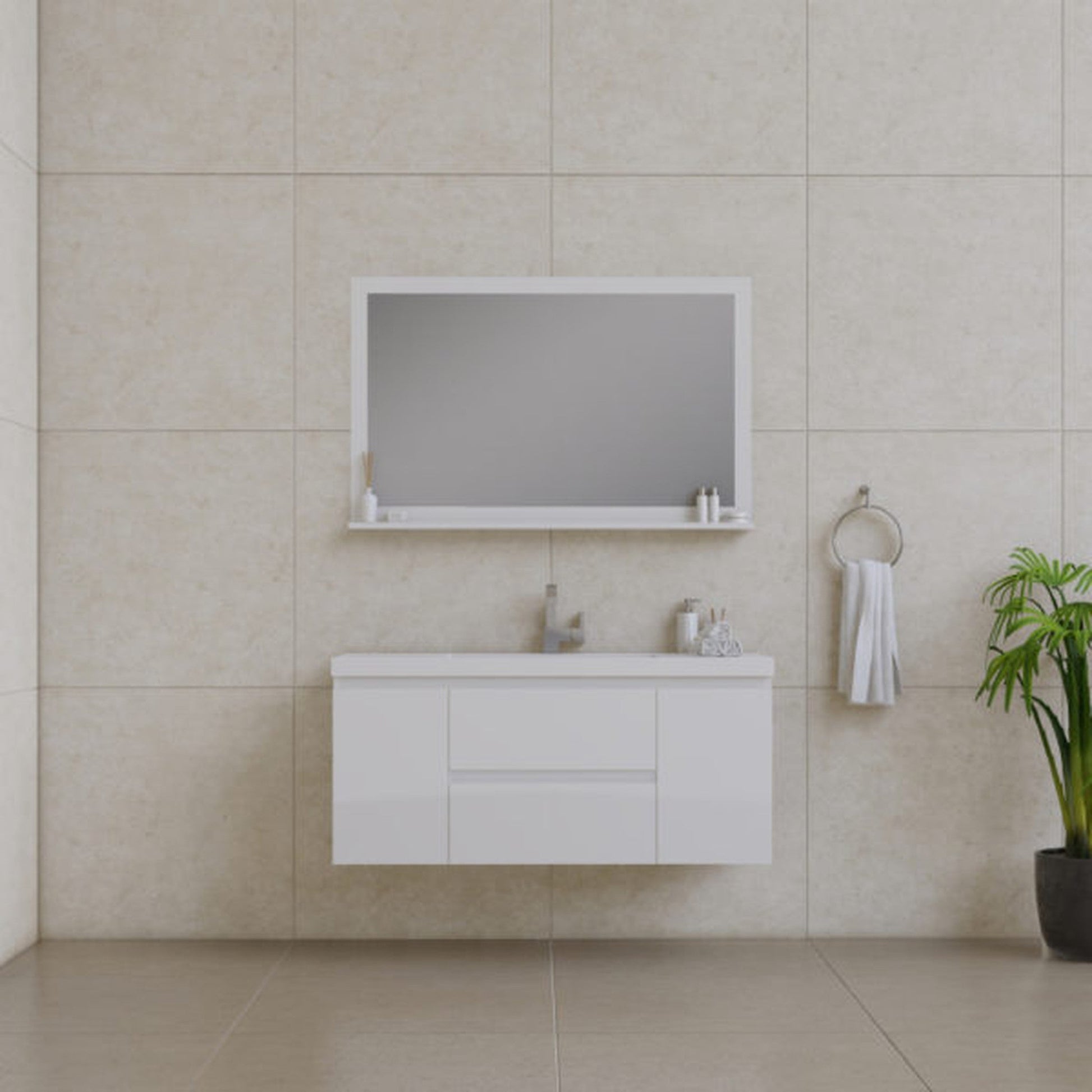
Authentic recovered Alya Bath catalogue image from the original Paterno portfolio entry. Historical depiction; it does not establish specifications for every model listed below. 6
Choose the mounting style before the finish
If you’re replacing a floor-standing cabinet, choosing a floating version by appearance alone can leave the wall support and plumbing unresolved. The older Paterno catalogue explicitly names Freestanding and Wall Mount designs. The later category pages use “Modern Bathroom Vanity” and “Wall Mounted Bathroom Vanity” as separate title groups; “Modern” is a style label, not a mounting instruction. 1 2 3
For a wall-mounted candidate, ask your installer to assess the wall construction against the exact model’s mounting instructions before finishing the wall. Request the attachment locations and support requirements rather than choosing fasteners from a photograph. The recovered Paterno category records don’t provide those instructions or a load rating.
For a freestanding candidate, confirm its footprint and any required wall attachment from its own documentation. Don’t assume a floor-standing cabinet can be converted into a floating unit. Our floating versus freestanding vanity guide explains the planning differences without treating the two versions as interchangeable.
Historical Paterno widths and sink arrangements
A width label can narrow your search, but it can’t tell you the cabinet’s exact depth or whether its drawers will clear your plumbing. For example, a 48-inch title is a starting point for comparing models, not an installation drawing. Use the size links below to compare preserved records, then confirm the particular Paterno dimensions before committing to the layout.
24, 30, 36, 42 and 48 inches
If you’re comparing compact cabinets, a 30-inch Paterno name still leaves the mounting style and basin layout to check. Keep those questions attached to the width as you review the historical choices.
The older catalogue names Paterno 24-, 30-, 36-, 42- and 48-inch designs in both Freestanding and Wall Mount versions. At each of these widths, the named finishes are Dark Gray Oak, High Gloss White and Rosewood. Those titles don’t explicitly say “Single Sink” or “Double Sink,” so the arrangement needs confirmation rather than an inference from a replacement illustration. 3
The category’s first page separately names 24- and 30-inch Modern Bathroom Vanity and Wall Mounted Bathroom Vanity cards in Gray, Rosewood and White. Its second page names the same title groups and finishes at 36 and 48 inches. 1 2
Compare the 24-inch , 30-inch , 36-inch and 48-inch vanity pages for size-specific catalogue evidence. The historical 42-inch Paterno names remain here because there isn’t a separate 42-inch page. Their absence from the later category’s width filter doesn’t erase the older named cards. 1 3
60 inches: single and double are distinct choices
If two people need separate basins, a 60-inch width alone won’t settle the choice. The older catalogue explicitly names 60-inch Single Sink and 60-inch Double Sink Paterno designs. Each arrangement appears in Freestanding and Wall Mount versions, with Dark Gray Oak, High Gloss White and Rosewood labels. 3
Keep the arrangement in your specification request. A single-basin drawing won’t establish the drain locations for a double-basin cabinet. The 60-inch single-sink page and 60-inch double-sink page provide separate comparisons; another collection’s detailed measurements aren’t Paterno specifications.
72 and 84 inches: check the named mounting evidence
If you’re planning a wide double vanity, the distinction between a named model and a filter option matters. The older catalogue names 72-inch Double Sink Paterno designs in both Freestanding and Wall Mount versions, each in Dark Gray Oak, High Gloss White and Rosewood. Its 84-inch Double Sink titles name Freestanding designs in those finishes. 3
The category filters also list 84 inches and Wall Mount. 1 3
Use the 72-inch comparison or 84-inch comparison to identify what documentation is still needed. Don’t transfer a Sortino 84-inch drawing to Paterno because the nominal widths match.
Keep the original finish labels in your request
If your project notes say “gray Paterno,” you could lose a useful distinction between source records. The category cards say Gray; the older catalogue says Dark Gray Oak. Likewise, White and High Gloss White are separate source labels. Rosewood appears in both groups. These records don’t establish that the shorter and longer names describe identical finishes. 1 2 3
Copy the exact finish label alongside the width, mounting style and named sink arrangement. Request a matching finish sample or a verified model photograph if color or sheen is important to your room. That gives the person checking the model a specific reference instead of asking them to interpret an incomplete name.
What the archived filters establish
The archived category showed “48 results”: the first page showed results 1–12 and the second showed 13–24. 1 2
The repeated filter values preserve useful collection-level evidence:
- Style: Modern, 48 results. Faucet Type: Single Hole, 48 results. Top Material: Solid Surface Resin, 48 results.
- Number of Sinks: Double, 17 results; Single, 31 results.
- Size: 24, 30, 36, 48, 72 and 84 inches, six results each; 60 inches, 12 results.
- Vanity Type: Freestanding, 24 results; Wall Mount, 24 results. 1 2
Treat Single Hole and Solid Surface Resin as historical collection attributes, not verified specifications for every named card. The older catalogue includes 42-inch names, while the category’s width filters omit 42 inches. That mismatch prevents us from reconstructing a complete model inventory by combining the filter counts. 1 3
Before selecting a faucet, obtain the exact top’s hole layout and dimensions. The faucet-hole spacing guide explains what to check; a collection filter doesn’t confirm faucet inclusion or model-specific compatibility.
Check the room as well as the cabinet
If a vanity fits along the wall but projects too far into the room, switching to wall mounting won’t restore the standing space in front of it. Measure the proposed countertop’s front edge against the opposite fixture, wall or obstacle. The National Kitchen & Bath Association’s Bathroom Planning Guidelines with Access Standards recommends at least 30 inches of clear floor space there. This is planning guidance, not a statement that every jurisdiction uses the same legal minimum. Check the requirements applicable to your project. 4
Use the vanity measuring guide to record the room and existing plumbing. For Paterno, request actual width, depth and finished installation height because the assigned collection records don’t supply model-specific measurements.
A floor gap also isn’t proof of wheelchair access. For example, a floating cabinet can still obstruct a seated user’s knees. The U.S. Access Board’s September 2021 lavatory guidance addresses forward approach, knee and toe clearance, faucet operation and protection from exposed plumbing. Covered accessible installations also have height requirements; wall mounting alone doesn’t establish compliance. No Paterno accessibility certification is established here. 5
Request the documents that settle the choice
If your shortlist reads “Paterno 60-inch Double Sink, Rosewood, Wall Mount,” keep that complete description when requesting specifications. Ask for the matching SKU, dimensioned cabinet and top drawings, drain and supply locations, and mounting instructions. Confirm usable storage around the plumbing before making changes to the room.
No Paterno specification PDF is identified in the assigned recovered records. The vanity installation guide can help you prepare questions, but it doesn’t replace a model-specific drawing. Send your exact historical model description to support@alyabath.com and request confirmation before setting the drain position or closing the wall.
References
- Alya Bath recovered Paterno category and collection filters
- Alya Bath recovered Paterno category page two
- Alya Bath older catalogue with named Paterno variants
- NKBA Bathroom Planning Guidelines with Access Standards
- U.S. Access Board Chapter 6 Lavatories and Sinks, September 2021
- Alya Bath original Paterno portfolio and recovered catalogue image