
Alya Bath · Planning and advice
Bathroom Vanity Trends for 2023: An Archived Perspective
Published: · Updated:
The bathroom vanity trends discussed here were Alya Bath’s outlook for 2023, originally published on December 9, 2022. Wood tones, wall-mounted cabinets, minimalist designs, double basins, better storage and luxurious finishes formed that outlook. This archived article keeps those ideas in their original historical setting; it isn’t a report of measured current trends. Planning and material-care advice was revised on November 27, 2026.
Alya Bath is a bathroom vanity manufacturer and distributor whose preserved company information describes a wholesale business serving resellers and trade professionals. Its catalogue gives you concrete cabinet and countertop examples to compare with the ideas below. Start with the bathroom vanity styles and collections hub to compare documented designs rather than assuming that a style label determines construction or suitability.
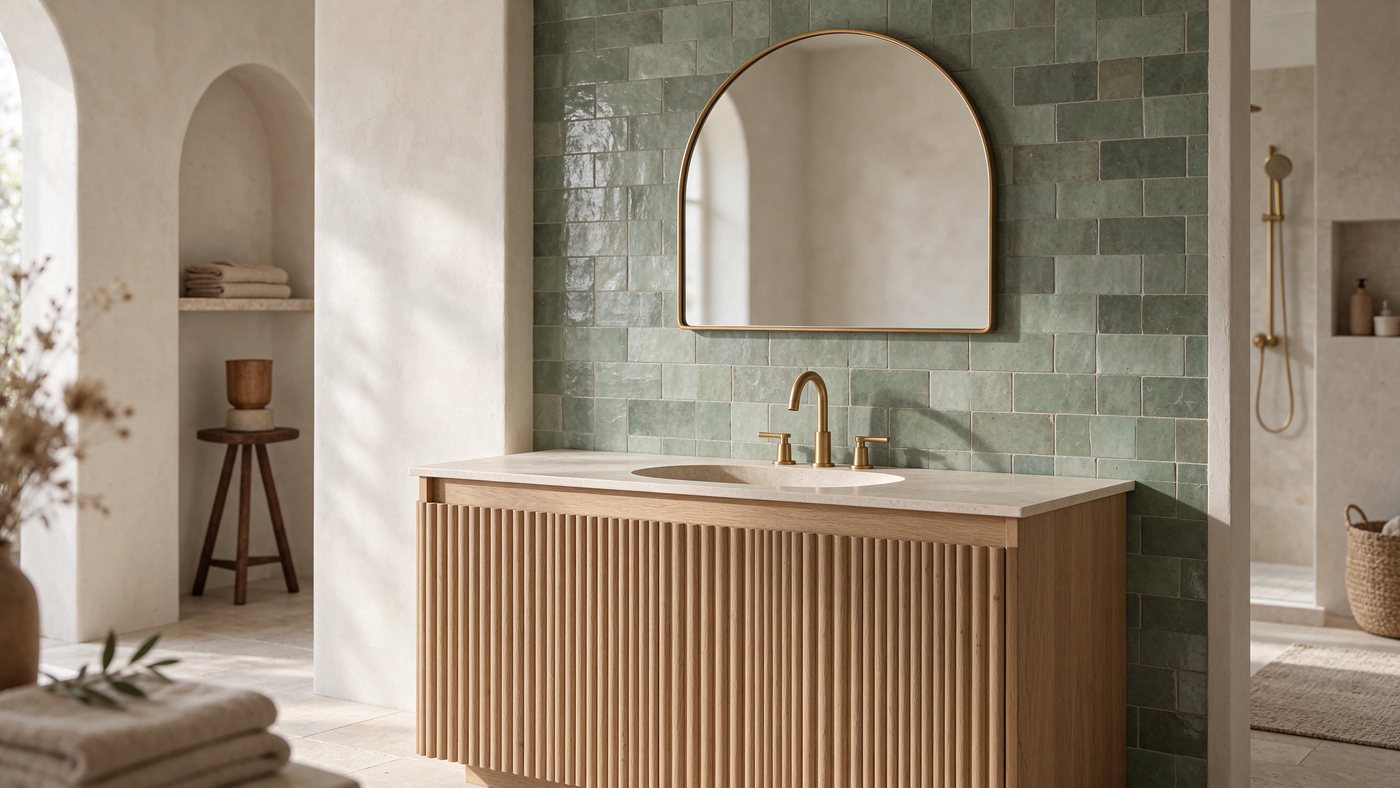
AI-generated new concept illustration; not a recovered original, actual Alya Bath product photograph, measurement, or verified depiction of any specific SKU or facility.
Wood tones: choose the finish separately from the cabinet material
A bathroom with pale walls and a white countertop can feel visually flat. The original article suggested wood tones as a way to introduce warmth and texture, with oak, maple and walnut as examples. Those names describe different woods, not a single light-colored palette: walnut can produce a much darker effect than pale maple or oak.
Compare samples beside your actual floor and wall finishes, under the lighting you’ll use. For example, a pale wood sample that looks neutral in daylight may look distinctly yellow beside a warm lamp. Choose the combination you like in the room rather than relying on a small online swatch. The original suggestion that wood matches almost any decor is too broad; grain, undertone and contrast all affect the result.
A wood appearance also doesn’t establish what’s inside the cabinet. Ask whether the visible surface is solid wood, veneer or another finish, and confirm the materials used for the cabinet box. The USDA Forest Products Laboratory’s 2021 wood handbook explains that wood moisture responds to surrounding relative humidity and that moisture control helps limit dimensional changes.1 A wood-toned cabinet still needs suitable construction and care.
The useful idea is to add visual texture without ignoring moisture exposure. Keep splashes from sitting on cabinet edges and address leaks promptly. The solid-wood vanity cabinet guide explains construction and inspection questions beyond the appearance of the fronts.
Wall-mounted vanities: visible floor isn’t extra walkway
A cabinet that extends to the floor can make a compact room look crowded. The archived article proposed wall mounting to expose the floor beneath the vanity. That can change the visual impression and make the floor easier to reach, provided the gap is accessible for cleaning.
It doesn’t automatically create more circulation space. A floating cabinet and a freestanding cabinet with the same projection from the wall leave the same distance to the opposite fixture. If your door catches the countertop, removing the vanity’s legs won’t solve the collision. Compare the complete top depth and the opening paths of doors and drawers.
Wall mounting also changes the installation problem. Before choosing it, have the installer confirm suitable wall support, the fixing method and the intended finished countertop height against the model’s instructions. Check where the drain and supply connections will sit; exposed floor space may also expose plumbing you hadn’t planned to see. Don’t select fasteners from an inspiration photograph.
Keep this historical idea when visible floor and cleaning access matter to you, but don’t trade away needed storage without a replacement plan. The floating versus freestanding comparison and vanity depth post address those different decisions.
Minimalist designs: make everyday storage part of the look
A clean-lined vanity can look calm in a photograph yet become cluttered once you add toothbrushes, cosmetics and hair tools. The original article favored sleek lines and restrained detailing. Its suggestion that these designs prioritize form over function isn’t a useful selection rule: a simple exterior can still contain practical storage.
For a hypothetical shared bathroom, start with the items both users leave on the counter. Check whether the proposed drawers can hold those items and whether you can reach them comfortably. A shallow compartment may work well for small grooming supplies but fail to accommodate a tall bottle. Exterior drawer count alone won’t answer that question.
Choose simple fronts if you like them, then test handles, drawer access and the available interior space. Confirm that the sink and plumbing don’t block the storage you expect to use. Minimalism remains useful here as a preference for fewer visible distractions, not a reason to accept a cabinet that can’t support your routine.
Double basins: solve simultaneous use, not an imagined space shortage
Two people needing the sink at the same time is a real inconvenience. The archived article suggested double-sink vanities for partners and families. In a hypothetical household where both adults brush their teeth during the same morning interval, separate basins may reduce waiting.
But if one person mainly needs mirror space while the other uses water, a second basin may not solve the main conflict. At a fixed countertop width, another basin occupies surface area that could otherwise be used for grooming or setting down supplies. More plumbing can also affect the storage below. Double basins don’t guarantee generous counter space or a compact installation.
Compare the sink arrangement before increasing cabinet size. Alya Bath’s documented catalogue includes separate 60-inch single-sink and 60-inch double-sink records. These offer a useful comparison without treating every vanity of the same nominal width as identical.
Sketch where each person stands, where daily items go and how drawers open during shared use. Ask a plumbing professional to assess any connection changes. The single versus double vanity post develops the routine and layout comparison; the historical idea remains useful when simultaneous sink use is the problem you actually need to solve.
Smart storage: plan around the drain and the objects you own
An empty cabinet can seem spacious until the trap, supply stops and tall bottles are inside it. The original storage examples were built-in drawers, cabinets and shelves, a custom cabinet beneath the sink, and open shelving above the toilet. “Smart” described useful organization here, not electronic features.
Make an inventory before choosing the storage layout. Put daily-use items where you can reach them without moving other supplies. Reserve deeper compartments for objects that need the height, and keep plumbing connections accessible for inspection and service. Don’t add an under-sink organizer until you’ve checked the available space around the trap and valves.
Open shelves suit items you’re comfortable leaving visible, but they create exposed surfaces to clean. For example, a shelf above a toilet might hold folded towels while enclosed storage keeps a changing assortment of bottles out of sight. Check reach, secure mounting and clearance before installing it; the location alone doesn’t make it useful.
This is one of the most transferable ideas from the archived article because it starts with a daily problem. Use the vanity storage post to compare access and the plumbing layout post to identify interference before adding compartments.
Luxurious finishes: include care in the decision
A striking countertop can disappoint if its care needs don’t suit your bathroom. The archived article proposed marble and quartz, then suggested a glass top or backlit LED mirror for a different visual effect. Keep those as design examples, not promises that every material is suited to heavy use.
Marble and quartz need different precautions
For example, marble’s veining may be the feature you want, but a vinegar-based cleaner can damage its finish. The Natural Stone Institute explains that acids can etch calcareous stones and abrasive cleaners can scratch stone. It also recommends heat-protective mats or trivets even though many stones tolerate heat.2 The original mention of marble’s heat resistance shouldn’t be read as permission to rest hot styling tools directly on it.
Quartz surfacing is generally an engineered composite containing crushed mineral material and a binder, commonly resin. Its composition differs from a slab of natural stone, and engineered stone can be damaged by direct heat or sudden temperature changes.3 The original description of quartz as “incredibly scratch resistant” didn’t establish scratch-proof performance for a particular countertop. Request the actual surface’s cleaning and heat-care instructions rather than treating the material name as a guarantee.
Alya Bath’s Norwalk collection describes Carrara marble tops, while Vanea records describe white quartz tops. Those are documented material choices, not comparative durability tests. Read the quartz versus marble post before deciding which care requirements fit your routine.
Glass tops and backlit mirrors are separate decisions
A reflective glass top may appeal to you, but the original article supplied no glass specification or matching Alya Bath model. Confirm the proposed top’s suitability for bathroom use, support requirements and cleaning instructions with its supplier before including it in a plan.
A backlit LED mirror can create a glow without necessarily lighting your face well. If grooming is the problem, assess the light at your standing position rather than choosing by the reflected effect alone. Check vanity lighting and mirror sizing , and have an electrical professional confirm the proposed installation meets applicable requirements.
Turn one archived idea into a workable choice
A trend list can leave you comparing appearances without resolving your room’s main difficulty. If you like the floating wood-vanity example but your present cabinet already works well, first identify what would improve: floor access, storage, counter room or the visual finish. Replacement isn’t the only possible answer.
Before committing to a cabinet, use the measuring post to record the available space and opening clearances. Then request the exact model’s dimensions, plumbing layout and installation instructions. That information will tell you whether the idea fits your bathroom—something a 2023 forecast, or any inspiration photograph, can’t establish.